AUTODYSSEY
Advice for first-time classic car buyers
All stories

The Long Read

Advice for first-time classic car buyers

The first classic decides whether the hobby keeps you. On classifications, the soft 2026 market, the driver-or-project fork, rust versus sun, and why the car that runs beats the car that waits.

By Autodyssey Editorial TeamJuly 29, 2026 17 min read

Introduction

You have examined your bank account and reached the only sensible conclusion available, which is that it contains too much money. You have also surveyed your garage and found that the tools and parts stored there fall well short of the volume required to call the space a workshop. Both problems have a single solution, and that solution has four wheels, no air conditioning, and a carburettor that will need adjusting on a Sunday in October.

Welcome. Hagerty estimates 18 million Americans have made the same decision, which works out to about 8 percent of everyone holding a driver's licence, so you are in reasonable company and none of you can be talked out of the idea.

We give this advice at Autodyssey to anybody buying a first classic. Some of it will save you money, and some of it will cost you money and be worth it anyway.

01 / 17

Classic, vintage, and antique

The vocabulary is a mess, and sorting it out is worth ten minutes of your time, because the Antique Automobile Club of America, your insurance company, the clerk at the registry, and the man judging your car at a show are all working from different dictionaries.

The AACA uses 25 years, which is the most widely referenced threshold in the hobby. Vintage almost always means built between 1919 and 1930, and a vintage car keeps the label even after somebody chops and modifies it, since the calendar is the only test. Antique usually means 45 years and older, which American Collectors Insurance draws at 1975 or earlier. The Classic Car Club of America runs the strictest door policy of the lot: a Full Classic must be a fine or distinctive automobile built between 1915 and 1948, from an approved list of makes, and no hearse, ambulance, or race car gets in.

State registries ignore most of those distinctions. Minnesota grants a collector plate to a vehicle at least 20 years old built after 1935 and operated solely as a collector's vehicle, with a second door for anything 10 model years old whose body or engine style saw no more than 500 units built or imported into the United States. California calls the same idea a Historical Vehicle and wants 1922 or later plus 25 years. Pennsylvania issues antique plates at 25 years and then defines your permitted occasional transportation as no more than one day a week.

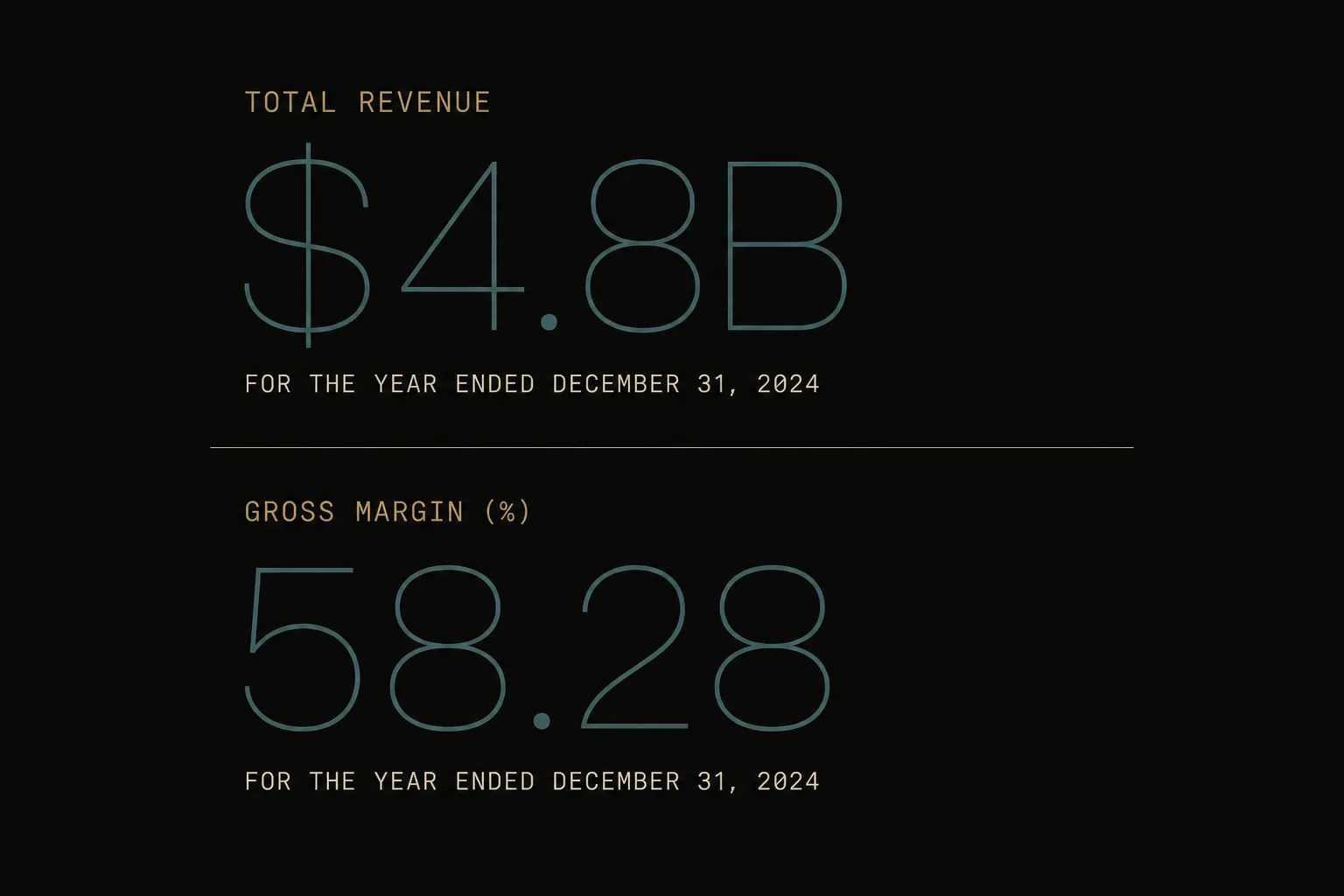
A minimal data page pairing the record 2025 auction total with the lowest Hagerty Market Rating in nearly fifteen years

The market in two numbers

Record auction totals at the top of the market, the softest rating in nearly fifteen years underneath it.

Class C · AI-generated

02 / 17

The 2026 market split

Two numbers from early 2026 disagree with each other, and the disagreement is the best news a first-time buyer has had in fifteen years.

Auction and online sales hit roughly $4.8 billion in 2025, up 10 percent year over year and an all-time record, with RM Sotheby's alone clearing a billion. Seven-figure cars crossed $1 billion in aggregate for the first time in market history. Meanwhile the Hagerty Market Rating, which reads the health of the market as a whole, fell to 58.28 entering 2026, its lowest in nearly 15 years, and had only crept back to 59.01 by March, still parked in flat territory between 50 and 60.

Both numbers are correct. The top of the market is on fire and the middle is the softest it has been since the years right after the financial crisis. Hagerty's own request data shows it plainly: among cars valued under $250,000, the ratio of members asking to raise their insured values rose in only one of the past 15 months, while the high end rose in eight of those months.

You are shopping in the soft half. The Ferrari crowd is bidding against itself in a tent in Monterey, and that has nothing to do with you buying a tidy Beetle in Saint Cloud in April.

03 / 17

Driver or project

This is the fork in the road, and the people who skip it are the ones selling at a loss eighteen months later.

If you want a driver, buy the finished car. Pay the premium for documented history, buy from a seller with a paper trail, and accept that the receipts in the folder are worth more than the shine on the paint. Then do the thing most first-time buyers forget, which is to find your mechanic before you find your car. Call two local shops, describe the make, and ask whether they will take the work. A shop that will happily service a Beetle and refuses to touch a Jaguar XJ6 has just told you something useful about which car you should be shopping for.

If you want to be a part-time mechanic, the calculation inverts and a needier car becomes the point instead of the problem.

Either way, understand what you are signing. These cars are 25 years old at minimum, and a 25-year-old car in genuinely lovely condition still breaks, because 25-year-old cars broke when they were new. The compensation is enormous: a classic is simpler, with fewer systems, fewer sensors, and fewer modules that need a subscription to interrogate. Parts are frequently easier to source for a 1968 Volkswagen than for a 2011 crossover, and that simplicity is the entire charm of the trade.

04 / 17

Selection filters

The filters that work are personal rather than financial, and either beats a spreadsheet.

The first is your birth year. A car built in 1972 by somebody born in 1972 gives you a fixed reference point and a machine that ages alongside you, and the constraint teaches you that model year's specific quirks faster than a forum will. It narrows the field hard, which is exactly why it works.

The second filter is stronger. Picture the car you wanted at twelve or thirteen, before you understood what money was. That is the poster that hung on your wall, and for a lot of people it is a Countach, a 911, or a Mustang fastback. Buying it now is a reward for whatever you have managed since, and you arrive already knowing things about it, which shortens the learning curve by a year.

Emotional connection is the fuel that gets you back into the garage in February, and the car you pick should supply it.

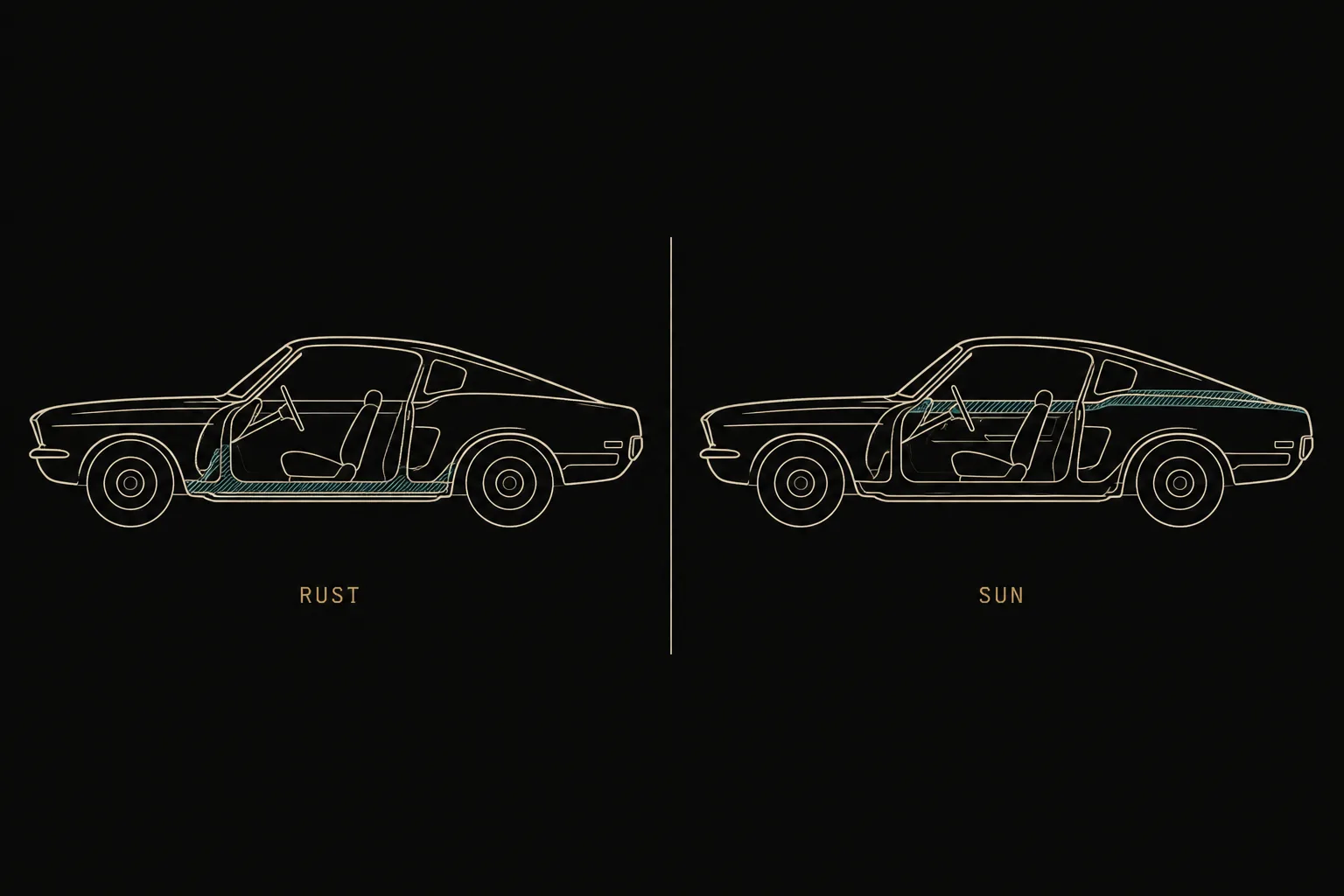
Two identical car silhouettes, one hatched along the rockers, floors, and frame rails, the other hatched across the dashboard and door tops

Rust map, sun map

A salted car rots from below while a sun-baked car wears its damage above.

Class C · AI-generated

05 / 17

Geography and condition

Where a car has lived matters more than its odometer, and where you live decides what the hobby costs you.

Minnesota is a genuinely excellent place to do this, and the numbers support the claim. The state has 2.4 million registered vehicles, of which 274,000 are at least 20 years old and collector-plate eligible, with roughly 24,000 built before 1950 in the Department of Public Safety's counts. Hagerty has ranked Minnesota the friendliest state in the country for classic cars, and RotoWire's scoring put it first with 840 points out of 900, ahead of Kentucky at 820, across criteria covering registration, inspections, taxes, emissions, titling, road quality, traffic, and weather. Back to the 50s at the State Fairgrounds every June pulls more than 10,000 owners of cars at least 60 years old.

One correction, since we went looking for the number: Minnesota ranks sixth among the 50 states for sheer quantity of collector cars, and its first-place finish is for friendliness, which scores the rules and the roads rather than the count. The reason so many cars live here is less exotic than any statistic. People have garages, January is long, and a heated garage in January beats almost anywhere else in the state.

The tradeoff is rust. An unrestored Minnesota car, and especially one stored outdoors, hides corrosion in the rockers, the floors, and the frame rails, in the places you cannot see without a jack and a flashlight. Southern cars have the opposite disease. Sun destroys dashboards, cracks door cards, and turns interior plastics to biscuit, and on a car that saw a 500-unit production run those pieces get genuinely hard to find. A sun-baked car wears its damage above, and a salted car rots from below. Warmer, drier climates generally produce the better starting point for anybody who would rather not learn to weld.

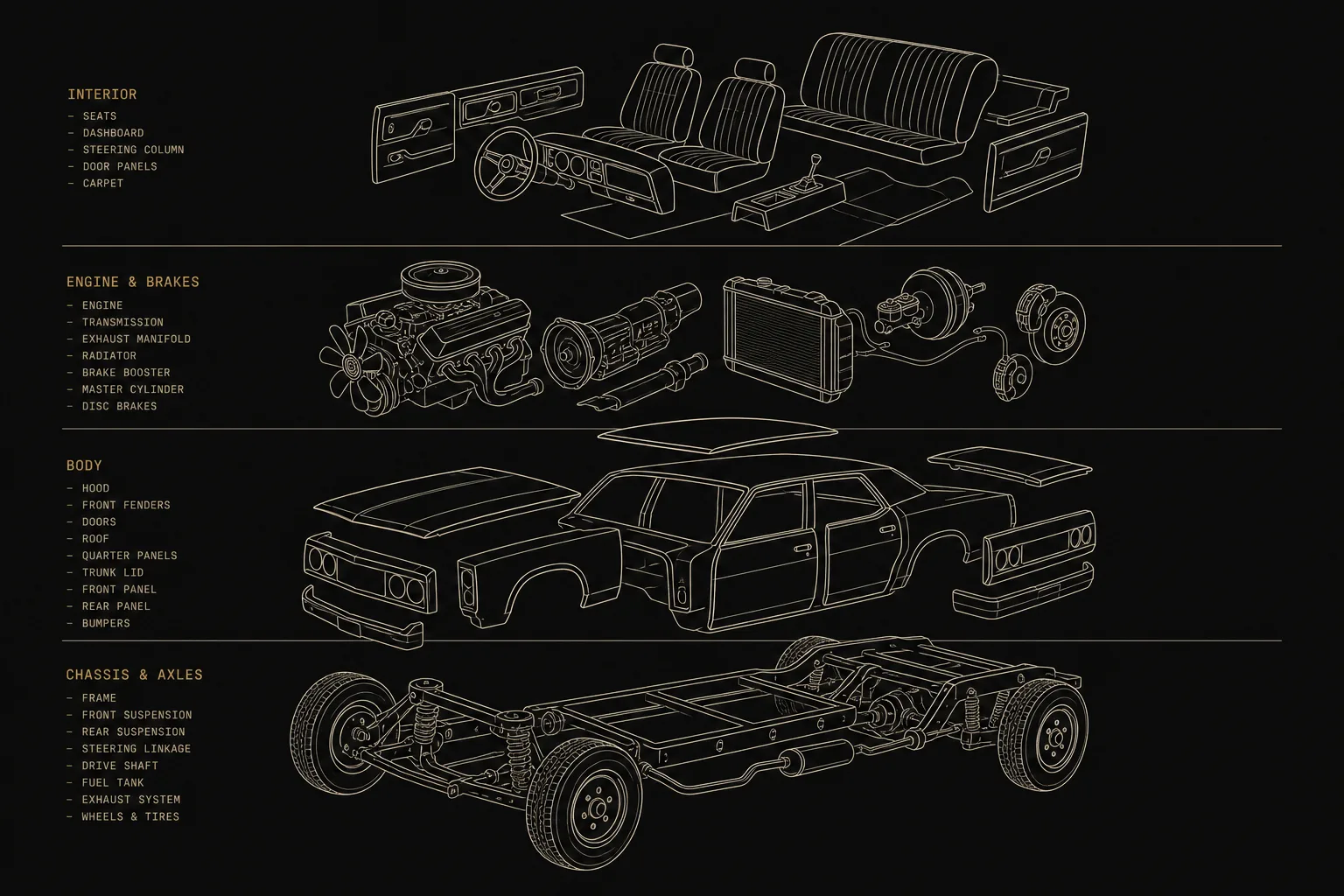
An exploded diagram of a 1970s sedan stacked by repair priority, chassis at the base and interior at the top

The repair hierarchy

Structure at the bottom decides the purchase, and everything above it is a known cost with a known supplier.

Class C · AI-generated

06 / 17

Fault priority

Rank the faults by what they cost to put right, which runs almost exactly opposite to the order they catch your eye.

Structural integrity comes first and it is close to non-negotiable: the chassis, the frame, the axles, and the mounting points. Body panels sit a tier below, because takeoffs from a donor car and new reproduction panels exist for most popular models, and a Beetle front fender is a catalogue item. Engines get rebuilt. Brakes, suspension, and fuel lines get rebuilt. Interiors get redone. Every one of those is a known cost with a known supplier.

Cosmetics and mechanicals are the easy end. A cracked dash on a low-production model from 1974 is the hard end, whatever the seller tells you.

07 / 17

The starter car

The best advice I ever heard given to a first-time buyer was to buy a Volkswagen, and the reasoning survives scrutiny.

Volkswagen built 21,529,464 Type 1 Beetles between 1938 and 2003, a 65-year run that remains the longest for any single generation of car, with roughly 15.8 million of them made in Germany. On 17 February 1972, Beetle number 15,007,034 came off the line and passed the Ford Model T's production record. What that means for you, standing in a garage on a Saturday, is that almost nothing you break is unobtainable and almost nothing you break is a mystery, because a few million people have already broken the same part and written down the fix.

The Beetle is also mechanically legible. The 1,584 cc flat-four comes out and sits on a bench where you can work on it standing up. New panels are available. It rewards modification without punishing originality. And it is a tremendously entertaining car to drive, which is the specification nobody puts in the classifieds.

08 / 17

Comfort expectations

People spend six figures learning the next lesson, and I would rather you had it for free.

A classic will drive like an old car no matter how much money goes into the restoration. Our standards moved. Manufacturing got more refined, tolerances tightened, and the modern car got quiet in ways that would have looked like witchcraft in 1974. A restoration buys you nostalgia, memory, and simplicity, and those are excellent things to buy so long as you know that is the transaction.

We learned this restoring Land Rover Defenders. People would put $100,000 to $150,000 into a Defender and stay surprised that it was uncomfortable, having skipped past the fact that it was uncomfortable when it was new. You can bolt on every creature comfort in the catalogue and the vehicle underneath remains, aerodynamically speaking, an open refrigerator proceeding down the road with an outboard motor bolted to the back. Hagerty put the 1983 to 1997 Defender on its Bull Market List, so the market agrees the thing is desirable, and desirable and comfortable are different words.

Drive the model before you buy the car. Drive several, in various conditions, and drive one in bad weather rather than only at a show on a July afternoon.

09 / 17

Clubs and meets

Car clubs are the most underused resource in the hobby, and the MG and European import crowds run particularly good gatherings.

Turn up at two or three with the model you want in mind. Talk to owners. They will tell you the failure points nobody lists, they will tell you what they overpaid for, and a meaningful number of them are either selling theirs or know precisely who is about to trade up. California supports 72 classic car clubs, Pennsylvania 52, and Florida 47, so this is no thin network. The best cars change hands before anybody photographs the car.

10 / 17

Ownership logistics

Commit to a real ownership period, and rent instead when you cannot. A classic for one summer of weekends is a rental, and treating it as one saves you the sales commission, the $400 to $1,000 insurance premium, and the storage bill.

If this is your only car, work through the failure modes now: the week it is down, and the places it will not suit. I drive a variety of smoky diesels, and parking near a street full of people eating dinner gets a different calculation than parking at a hardware store. None of them has air conditioning, so at 100 degrees I take the modern car.

Registration law decides this for you in several states, starting with Washington, which requires proof of a second registered vehicle used for daily driving before it will issue a collector plate. Virginia makes you certify that you own or regularly use another vehicle without antique plates. Pennsylvania caps you at one day a week. Work out where the line sits between your primary car and your secondary car before the plate arrives, because that plate is a legal promise about how you will use the thing.

11 / 17

The pre-purchase inspection

Pay for a pre-purchase inspection, and the AACA has chapters in most states whose members will know who inspects your make locally.

Then bring a friend or a family member who knows vehicles and does not love this particular car. Their job is to be the rational party in a transaction where you have already parked the car in your driveway in your head, because emotion is what makes this hobby worth doing and it is also what wires a $30,000 deposit on a car with a soft frame rail and fresh paint over filler.

12 / 17

Setbacks and budget

Almost everybody enters this assuming the best case, and I want to say the next part with real warmth: it rarely goes perfectly.

Budget for that. Learn the fundamentals, at least to a 101 level on the basic systems, and talk to other owners until the vocabulary sticks. We are building a couple of courses at Autodyssey for exactly this reason. Carry a small set of tools even if you cannot yet use them, because the person who stops to help you on a county road will need something to work with, and turning up empty-handed at your own breakdown makes a poor first impression.

13 / 17

Acquisition routes

There are romantic ways to acquire a classic car and there are ways that work.

The barn find is real. Somebody's spouse passes, the family wants the car to go to a keeper instead of a flipper, and the price reflects that wish. These sales happen: VanDerBrink Auctions put more than 100 cars from a single Minnesota farm collection across the block in Beardsley, ranging from the 1920s to the 1970s, and many of the lots were rusted hulks better suited to supplying parts than transportation. Those cars go to people deeply connected in the hobby, and connection takes years, so treat the barn find as a possible reward for participation instead of a purchase strategy.

The car that has sat for 30 years under a tarp looks magnificent on television. Then you put fluids in it and drive it and the thing comes apart, because seals dried, hoses cracked, fuel turned to varnish, and every rubber component aged without moving. Sitting is what kills these cars.

Your first one should be a car that runs and drives, and it should start on the second turn of the key in a cold garage in November. Which brings me to the best advice about old cars I have ever been given, from my father:

His reasoning was that the moment the engine comes out, or the moment you find yourself 6 weeks into waiting for a part from a supplier in Germany, you lose interest, and the loss is inevitable rather than a failure of character.

I ignored the advice for years. Then I blew the timing belt on my Porsche 928. I pulled the cover, looked at the shredded belt, put the cover back on, and pushed the car into the garage. It went into storage, and it has been sitting for roughly ten years. I am still attached to that 928, because it was my first classic car, and somewhere in the back of my head I am permanently reserving a weekend to finish what I started. That is a spectacularly impractical way to hold an asset, and it is also exactly why any of us keep old cars.

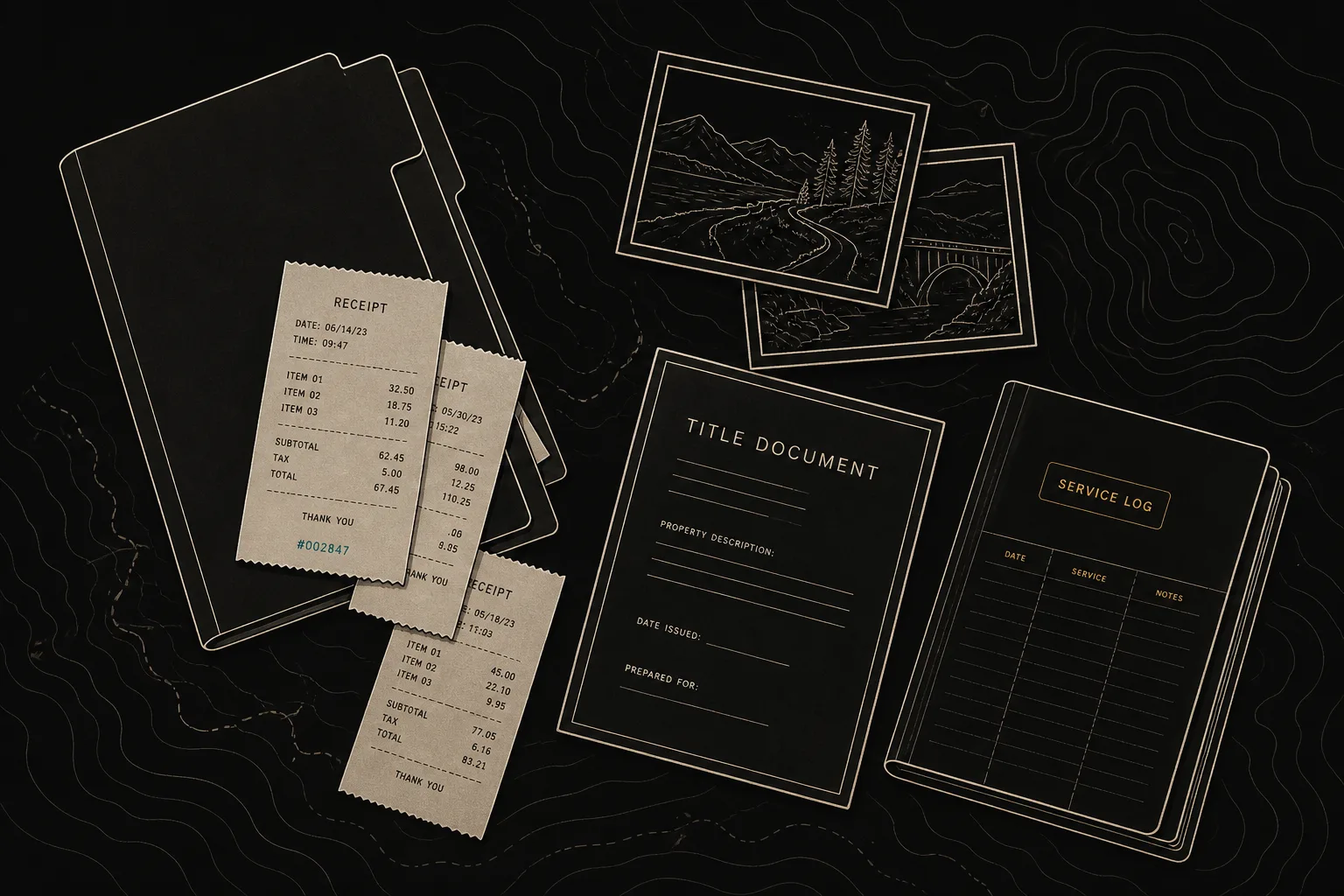
A flat-lay of a folder spilling receipts, photographs, a title document, and a service log book

The record that survives you

Receipts, photographs, the title history, and the service log outlast every owner on the chain.

Class C · AI-generated

14 / 17

Provenance and stewardship

A classic car is a record with a chassis underneath. The receipts, the photographs, the title history, the ordinary Tuesday oil change, and the one extraordinary winter somebody spent taking it to bare metal are the parts that survive you.

You are less the owner than the current keeper. Buy the car that connects to you, buy the one that runs, keep it running, and write down every repair, which is the entire reason the Vault exists at Autodyssey. The car will outlast your tenure, and the record is what makes the next keeper trust you.

Start your car's record in the Vault

15 / 17

Next in this series

The series continues with the pre-purchase inspection, on exactly what to examine and what to ask a seller before money moves. The price of paint follows, on why a respray runs from $395 to more than $100,000 and what you are paying for at each tier, then a field guide to the project car, covering budgets, timelines, and the month everything stalls. The series closes with what makes a great classic, on the traits that separate a car people keep for 30 years from a car people flip in 8 months, and the collectibles worth watching, on what is moving now and what the Hagerty data suggests comes next.

16 / 17

Sources

Minnesota Department of Public Safety registration figures via the Star Tribune; Hagerty Media on market size, the Hagerty Market Rating, the Bull Market List, and 2026 market analysis; RotoWire state rankings for collector cars; the Antique Automobile Club of America and the Classic Car Club of America on classification; American Collectors Insurance on vintage, antique, and classic definitions and on antique plate eligibility; WalletHub on classic policy costs; Washington State Department of Licensing, Virginia DMV, and the Pennsylvania Code on collector registration; VanDerBrink Auctions via Fox News on the Beardsley collection; Volkswagen Type 1 production figures via Wikipedia and Volkswagen historical records.

17 / 17

Frequently asked questions

How old does a car have to be to be a classic?

Most of the hobby uses 25 years, following the Antique Automobile Club of America, which is the most widely referenced threshold. State registries vary: Minnesota plates a collector vehicle at 20 years, California requires 25 years for a Historical Vehicle, and Florida and Texas use 30 years for antique registration.

What is the difference between classic, vintage, and antique?

Vintage means built between 1919 and 1930. Antique generally means 45 years and older, which American Collectors Insurance places at 1975 or earlier. Classic is the loosest term, typically 20 to 45 years, except at the Classic Car Club of America, where a Full Classic means an approved fine or distinctive make built between 1915 and 1948.

What is the best classic car for a first-time buyer?

A Volkswagen Type 1 Beetle is the standard recommendation. Volkswagen built 21,529,464 of them across 65 years, so parts, documentation, and community knowledge are abundant, and the 1,584 cc flat-four can be removed and worked on at a bench.

Is 2026 a good time to buy a first classic car?

The entry and middle segments are soft. The Hagerty Market Rating entered 2026 at 58.28, its lowest in nearly 15 years, and cars under $250,000 saw insured-value increase requests rise in only one of the past 15 months, while record auction totals of roughly $4.8 billion in 2025 came from the top of the market.

Do I need a second car to register a classic?

In several states, yes. Washington requires proof of a second registered vehicle used for daily driving. Virginia requires you to certify you own or regularly use another vehicle without antique plates. Pennsylvania limits antique-plated vehicles to occasional use, defined as no more than one day a week.

Should I buy a classic car that has been sitting?

Not for a first purchase. Seals dry, hoses crack, and fuel degrades while a car sits, so a vehicle parked for decades typically fails soon after it returns to the road. Buy one that runs and drives.

Are Minnesota classic cars a rust risk?

Yes, particularly unrestored cars and cars stored outdoors. Inspect rockers, floors, and frame rails. Southern cars carry the opposite risk, with sun damage to dashboards and interior plastics that can be difficult to source on low-production models.

How much of the US car population is collectible?

Hagerty estimates roughly 43 million vehicles meet its collector definition, about 16 percent of the 275 million registered vehicles in the United States, owned by an estimated 18 million people.

Tags

first classic carbuying guideclassic car marketVolkswagen Beetleprovenance