AUTODYSSEY
The car on the wall
All stories

The Long Read

The car on the wall

A restoration after-shot can become a visual milestone, a practical design study, and the reminder that keeps an unfinished car moving forward.

By AUTODYSSEYAugust 24, 2026 7 min read

Introduction

Most restorations spend longer as intentions than they do as cars.

They begin as a photograph on a classified listing, a trailer arriving after dark, and a small ceremony in which everybody agrees the rust is “mostly surface.” Then comes the inventory. Boxes gather. The engine leaves. One door occupies a workbench for six months. The finished car remains perfectly clear in the owner’s head and completely invisible to everybody else.

Restoration Vision gives that invisible car somewhere to exist.

It uses the photographs already filed in the Garage to build an after-shot of the same vehicle at a chosen stage. The result can hang above the real car, live beside the project plan, or travel on a shirt while the vehicle itself remains incapable of travelling anywhere.

This is not a prediction. It is a visual milestone: specific enough to guide the work, flexible enough to change with it, and good enough to remind the owner why another evening under the dashboard is worth having.
01 / 08

The missing photograph

A conventional before-and-after story requires an after.

That is inconvenient during the years when the car is spread across shelves. The before photograph is easy. It shows faded paint, missing trim, questionable wiring, and whatever the previous keeper attempted with household sealant. The after photograph cannot be taken until the work is finished, which is precisely when motivation no longer needs much assistance.

An imagined after-shot moves that photograph to the beginning.

Choose the view that best explains the car. Add the other angles that reveal its roofline, trim, wheels, interior, damage, and the awkward detail that distinguishes it from every cleaner example on the internet. Then describe the version you are trying to reach.

The render does not replace the project plan. It gives the plan a face.

02 / 08

The reference set

Restoration Vision works from ten, fifteen, or twenty photographs because one flattering angle is a poor witness.

Ten photographs can establish the main proportions and a clear finish direction. Fifteen add the details that make the vehicle particular: wheel design, ride height, brightwork, interior color, panel condition, and the relationship between repairs made in different decades. Twenty are useful when the car has complicated history, custom fabrication, mismatched panels, or a future that depends on details visible only from beneath a layer of dust.

The larger set does not exist to impress the machine. It exists to stop the machine from inventing a different car.

One photograph becomes the hero view. The full set becomes the vehicle fingerprint. The rendering tools read the fingerprint, then composite the requested color, graphics, material, texture, stance, and level of restoration onto the car filed in the Garage.

03 / 08

Restoration levels

The finished version does not always need flawless paint and a mirrored floor.

A preservation vision keeps the marks that prove where the car has been. Mechanical work can be complete while thin paint, worn leather, old decals, and a repaired quarter panel remain visible. The objective is not neglect presented as taste. It is a clear decision about which evidence deserves to survive.

A road-ready vision shows the version built for regular miles. The finish is careful rather than theatrical. The seals work, the lights agree with one another, the interior can tolerate a wet coat, and the car looks happiest outside a hotel at seven in the morning.

A concours vision asks for period-correct material, trim, fit, and finish. It is useful when originality matters and every shortcut will eventually stand beneath somebody’s flashlight.

A reimagined vision allows a disciplined restomod. Wheels, stance, paint, upholstery, and fabrication can move beyond the factory brief, but the original car must remain recognizable. Creativity has failed if it produces a handsome stranger.

04 / 08

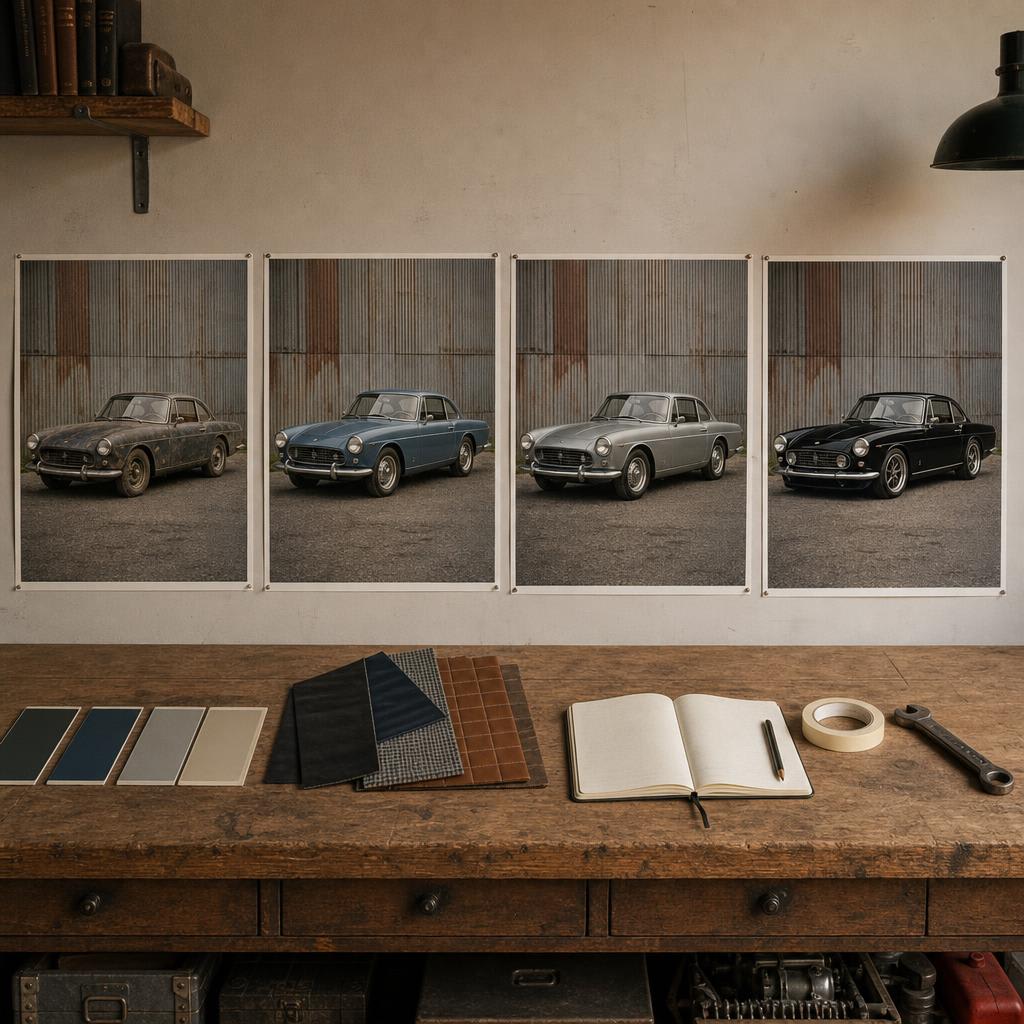
The stage collection

One final image can become a tyrant.

It fixes the destination too early, then quietly accuses the project whenever money, parts, taste, or life alters the route. A collection works better. Each vision records a stage that would count as progress on its own.

The first might show the body preserved and the car mechanically dependable. The second can add paint, trim, and the correct wheels. A later image may explore the interior, a period rally treatment, or the expensive finish that remains sensible only while looking at it.

Four visual milestone prints of the same vintage coupe progressing from preserved patina to a finished custom restoration above a workshop bench

Visual milestones

A restoration can have several credible destinations. Each print records the version worth reaching next.

Class C · AI-generated

Collecting the stages turns changing direction into part of the record. The abandoned color scheme is no longer wasted thought. It becomes evidence of what the keeper considered, what the car resisted, and how the final decisions emerged.

05 / 08

The Garage

The chosen render is filed into a private Restoration Vision gallery with the story behind it.

The story matters because “green paint” is not a reason to finish a car. A useful milestone explains what that version makes possible. It might be the first version safe enough for a long drive, the specification a parent remembers from childhood, the finish intended for a particular event, or the point where a dormant project returns to being transport.

That account joins the vehicle timeline. Months later, when the work has become a sequence of invoices and stubborn fasteners, the image still shows the destination and the story still explains why it mattered.

Privacy remains the default. A project in pieces does not owe the internet a progress report. The keeper can decide when the render, the real car, or the distance between them deserves an audience.

06 / 08

The physical reminder

A digital render belongs in the project record. A physical one belongs where motivation tends to disappear.

Put the poster above the car. Pin it beside the parts list. Carry the image on a shirt to the swap meet where the missing trim will allegedly reveal itself. Print a new stage after the first drive and leave the old one underneath it.

The object does not pretend the work is complete. It makes the intended completion difficult to forget.

A garage wall is particularly good at this. It has no feed, no notifications, and no opinion about elapsed time. The picture stays in the same place while the shell gains paint, the boxes empty, and the car beneath it begins to resemble the promise.

07 / 08

Honest visualization

An AI after-shot can be persuasive enough to create false confidence.

Paint can appear without bodywork. Wheel offsets can become physically diplomatic. A missing piece of trim may return from the dead because the model has seen one elsewhere. The image must therefore be treated as a design study, not a restoration estimate, fitment drawing, engineering approval, or guarantee that a particular finish will behave under real light.

The useful response is not to make the image vague. It is to make the owner specific.

Protect the details that matter. Name the pieces that will change. Record the desired level of finish. Compare the result with the source photographs and reject the handsome version that loses the identity of the car.

The best render does not show the most expensive outcome. It shows the next outcome that still feels like yours.

08 / 08

The next version

Restoration projects survive on practical progress, but practical progress is often too small to admire from across the room.

A labelled bag of fasteners is progress. So is a cleaned earth point, a measured panel gap, and the first brake line that does not resemble an archaeological find. None of them looks much like the drive you were promised when the car arrived.

The after-shot reconnects those small jobs to the larger intention.

Make one for the version that runs. Make another for the version that crosses the country. Keep the strange color experiment. Print the one that wins. File each stage in the Garage, and let the real car catch up in its own time.

What is Restoration Vision?

Restoration Vision uses ten, fifteen, or twenty photographs of a member’s vehicle to create AI-assisted after-shots in selected colors, patterns, textures, and restoration levels. A chosen result can become a private Garage milestone, digital render, poster, or custom product.

Does the render predict the finished car?

No. It is a visual design study and motivation tool. It does not replace measurements, paint samples, fitment checks, engineering advice, restoration estimates, or professional inspection.

Why use more than one photograph?

Multiple angles document the exact vehicle’s proportions, trim, wheels, damage, interior, and unusual details. The reference set reduces the chance that the rendering tools substitute a cleaner but different example.

Can one car have several Restoration Vision stages?

Yes. Each vision can represent a separate milestone, such as preservation, road-ready restoration, concours finish, or a later restomod direction. The selected render and its story are collected in the vehicle’s Garage.

Tags

car restorationAI car renderrestoration inspirationgarage wall artproject car motivation