AUTODYSSEY
The Surveillance Disclosure and Consent Act
All stories

The Long Read

The Surveillance Disclosure and Consent Act

A model bill for the four signs, offered to any council, any statehouse, and any citizen willing to carry it up the steps. The follow-up to The Cameras Came Quietly, written as a law you can sign.

July 17, 2026 16 min read

Introduction

Bill No. 2026-01 · A follow-up to The Cameras Came Quietly · Filed by a keeper, on behalf of the watched

I spent quite a number of years operating a workshop in England, learning roads that seem to have been laid out by a committee of drunk cartographers, and forming strong opinions about roundabouts that nobody asked me to share. The thing that followed me home wasn't the weather, the tea, or the driving on the wrong side; it was the signage. Britain watches its drivers with an enthusiasm that has long since crossed from policy into hobby, and Britain, to its lasting credit, tells you so. Every camera announces itself with a big, beautiful sign on the side of the motorway, a yellow board the size of a garden shed carrying a drawing of a camera and lettering you can read at fifty miles an hour, and the whole cheerful arrangement exists to tell you that Big Brother is watching and wanted you to know.

Britain is a shambles on this front, and I'll say so plainly, because a country that reads fifty million number plates a day and files them in a data centre in Hendon has lost the thread of something important. The cameras multiply, the retention creeps from months into years, and Privacy International's Simon Davies once warned the whole apparatus handed police "extraordinary powers of surveillance" of a kind that "would never be allowed in any other democratic country." He was right to worry. Yet the British, for all their overreach, kept one plain habit that we've thrown away entirely: they put up the sign. They tell you the road is watched. They give you the courtesy of knowing, and in the roughest corners of London where knife crime is a genuine emergency, that visible, announced, accountable watching has done real good and saved real lives.

America looked at that arrangement and decided the announcing was the part to cut. We kept the watching, doubled it, sold it to a private company you've never voted for, and took down the signs. That company is Flock Safety, and its cameras now sit on poles in more than five thousand American communities, roughly ninety thousand of them at last count, quietly reading your plate, logging your car, and stitching your movements into a national web that a police department three states away can search on a Tuesday afternoon by clicking a button marked "Enable National Lookup." One thirty-day audit handed to the ACLU counted more than four hundred and fifty thousand searches. A Texas officer typed "had an abortion, search for female" into the reason field. Federal immigration agents reached into the pile without a single local official signing off. The camera on the pole outside your kids' school said nothing about any of it, because saying nothing is the whole design.

Here's the part that should chill a person of any party, and it's a matter of plumbing rather than politics. No citizen voted for this, no citizen demanded it, no referendum was held, no ballot line was printed, and no representative stood on a stage and campaigned on the promise of a private surveillance grid keyed to your license plate. These systems arrived through procurement, through the consent agenda, through committee rooms with the good chairs and the bad coffee, signed off by people who were shown a demo, promised a crime rate that would fall, and handed a network that does a great deal more than they were told. We're a constitutional republic and a representative democracy, which means the citizen is meant to be the author of the arrangement, and the citizen was never even shown the contract.

So I stopped complaining and wrote the fix. It doesn't ban a single camera. It doesn't blind a single investigator chasing a genuine criminal. It asks for one thing that the surveillance-drunk British already do and the marketing-drunk Americans refuse to: put up the sign. Tell people the road is watched, tell them who's watching, tell them where the data goes, and let a free person decide whether to drive that street, take another, or turn around and go home. What follows is the bill.

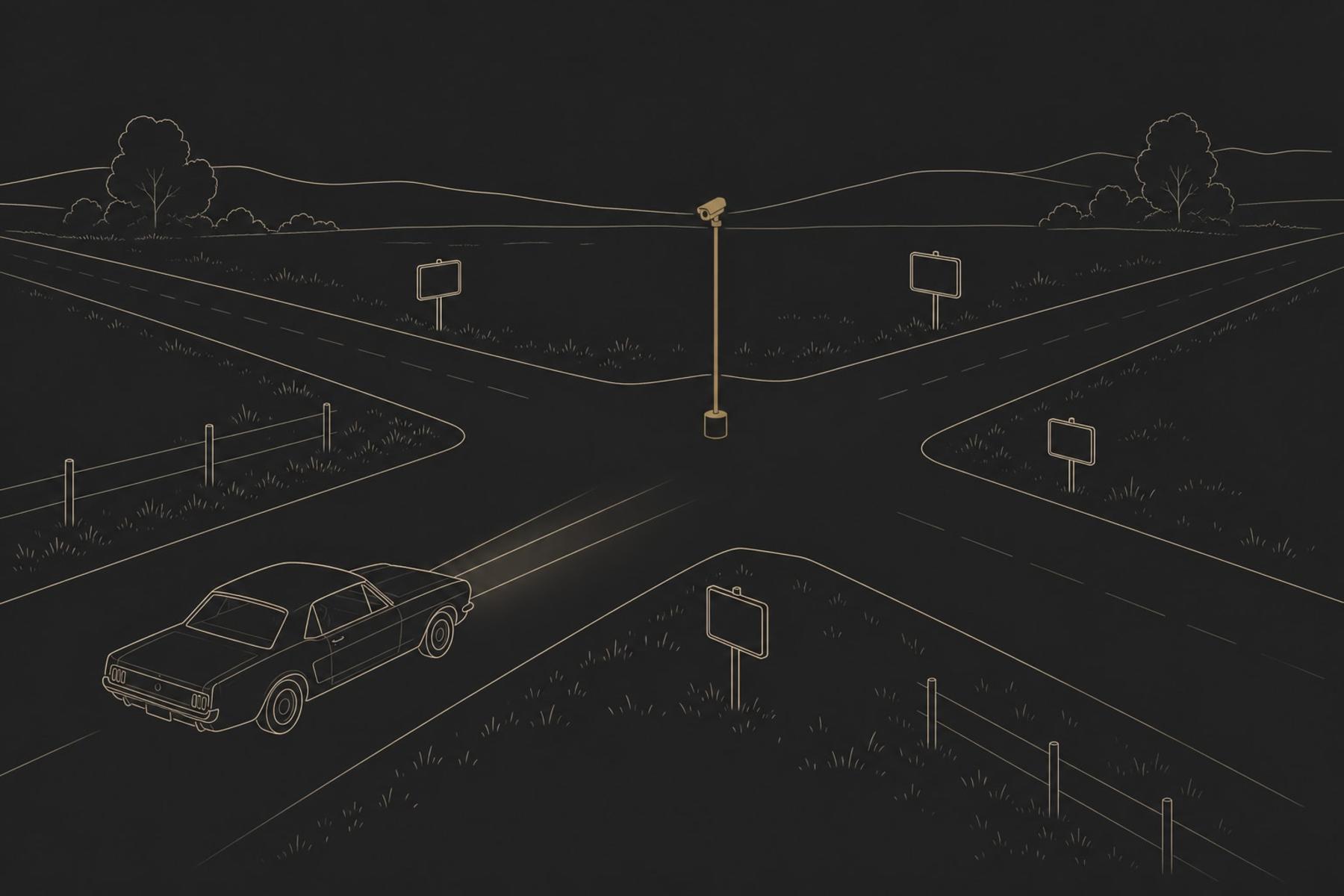
A black Jaguar E-Type with a FLOCK OFF number plate driving away down a wet country lane at dusk, past a British camera-warning sign on a pole

The sign and the car

A British camera-warning sign does the one thing ninety thousand American cameras refuse to: it tells you.

Class C · AI-generated

01 / 06

What the Surveillance Disclosure and Consent Act Requires

§1. Short Title

This Act may be cited as the Surveillance Disclosure and Consent Act, and referred to plainly as the Four Signs law, because that's what it comes down to.

§2. Findings

Whereas a private company now operates a nationwide network of automated cameras that read, record, and store the movements of ordinary drivers who are suspected of nothing;

Whereas that data is routinely shared across state lines and into federal databases, giving distant agencies a searchable map of a citizen's daily life;

Whereas the citizens subject to this watching were never asked, never warned, and in most cases were never told the cameras existed;

Whereas the Fourth Amendment protects the people against unreasonable searches, and the Supreme Court held in Carpenter v. United States that the long-term tracking of a person's movements can constitute exactly such a search;

Whereas a free country that insists on watching its people owes them, at the barest minimum, the knowledge that they're being watched and the freedom to choose another road;

Now, therefore, the following is enacted.

§3. Definitions

A Covered Camera Network means any system of one or more automated cameras, including automated license plate readers, that records vehicles, plates, faces, or movements and links that record to any state or national database, or grants any government agency access to search it.

An Operator means any company, agency, or entity that owns, runs, or supplies a Covered Camera Network, whether public, private, or the increasingly common blur of the two.

A Linked Database means any repository, local or federal, that a Covered Camera Network feeds, queries, or makes its records searchable within.

§4. Mandatory Disclosure Signage

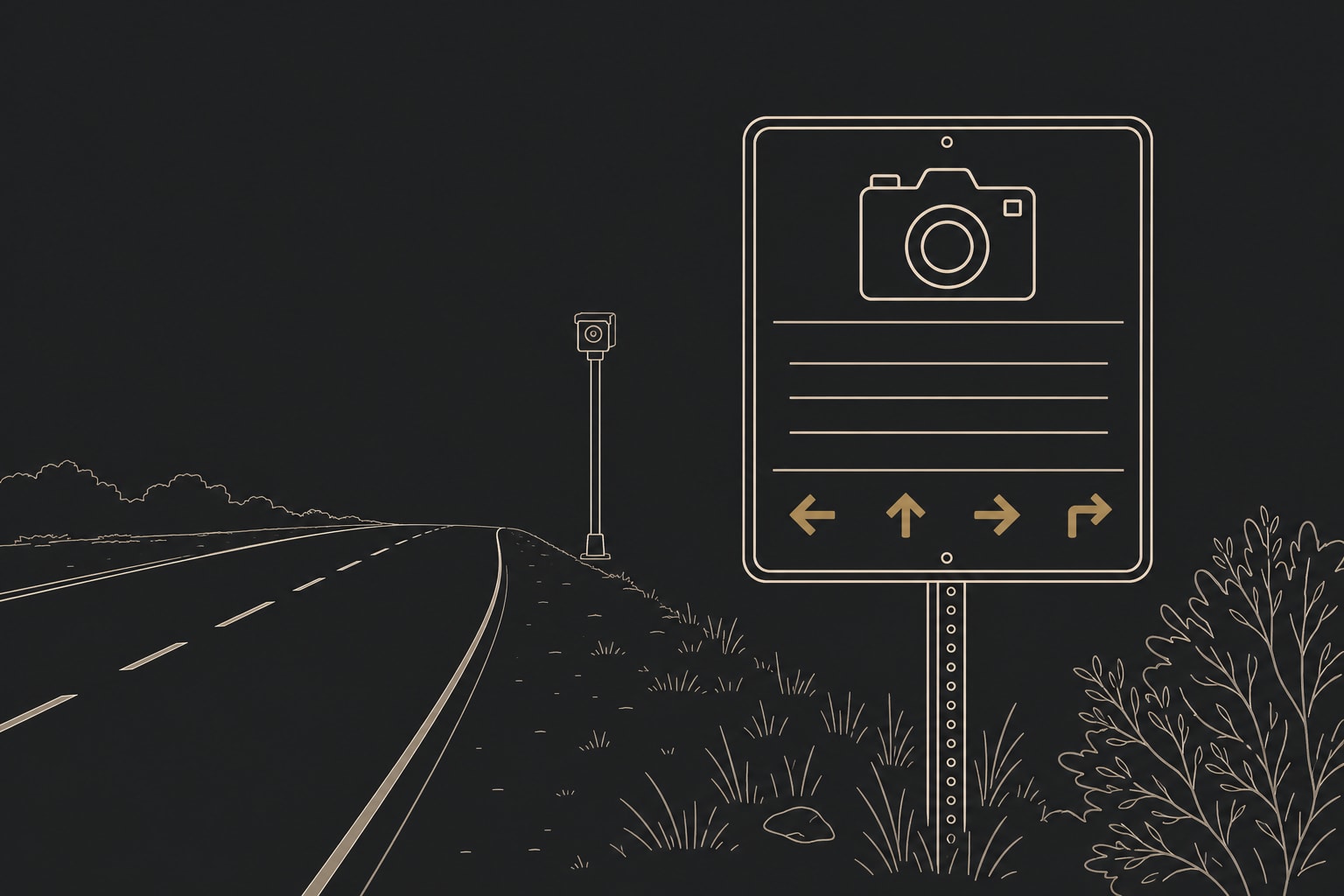
An Operator of a Covered Camera Network shall post clear, legible signage disclosing the surveillance at every point of approach to the watched area. Signage shall face all four cardinal directions of approach, so that a driver entering from any road is told before the camera reads them, rather than after.

Each sign shall be reflective, weatherproof, and legible from a moving vehicle at the posted speed limit, and shall sit no closer than the stopping distance for that speed, so that the disclosure functions as a choice and not a jump scare.

§5. Required Content of the Sign

Each sign shall state, in plain language a driver can read at speed, the following: that the area is surveilled by a private or government camera network; that the vehicle, plate, and movements may be recorded, stored, and shared with state and federal databases; the name of the Operator; the network's public registry identifier; and a clear indication of where the camera is.

§6. Scope and Applicability

This Act applies to every Covered Camera Network linked to a state or national database, and to every camera that provides direct government access to its records, regardless of who holds the title to the pole. A camera owned by a private company but searchable by a federal agency is government surveillance wearing a corporate coat, and this Act treats it as such.

§7. The Right to Choose the Road

The disclosure required by this Act exists so that a citizen may exercise a choice: to accept the watching of their government, to accept the watching of a private company sharing data across federal networks, or to turn and take a different route entirely. A free person is entitled to know which of those three they're choosing, and to choose it knowingly.

§8. Public Registry

Each Operator shall maintain a public, searchable registry of every camera location, its owner, and every database its records feed. Surveillance conducted on the public in secret is the injury; a public record of who watches whom is the plain remedy.

§9. Enforcement

An unsigned camera is an unlawful camera, and its records are inadmissible for any purpose while the disclosure is absent. Any citizen surveilled by an undisclosed Covered Camera Network shall have a private right of action against its Operator, and the cost of the signs falls, in every case, on the party that chose to do the watching.

§10. Severability, Effect, and Review

Should any part of this Act be struck, the rest stands. The Act takes effect the day it's signed, applies to cameras already installed as much as those yet to come, and returns to the people's representatives for public review every five years, in open session, with the minutes published and the coffee, one hopes, improved.

A monoline illustration of a roadside disclosure sign carrying a camera pictogram, blank fields, and four directional arrows, with a camera on a pole further down the road

The mandated sign, illustrated

One like it faces each of the four directions of approach, which is the entire radical demand of this bill.

Class C · AI-generated

02 / 06

Why Every Political Party Should Sign the Four Signs Law

Surveillance is the rare subject that unites people who agree on nothing else, because the camera doesn't check your voter registration before it reads your plate. Here's the case each of them would make in their own language, and each one holds.

The Progressive

You sign because surveillance has never once fallen evenly, and it won't start now. The same network that promises safety has already been used to hunt a woman for a suspected abortion, to feed license plates to immigration agents who never asked a local official, and to map the movements of the neighborhoods that are always watched first and trusted last. A grid that can chill a protest, track a clinic visit, and inventory a community is a civil-rights problem wearing the uniform of public safety, and disclosure is the floor beneath any real consent.

The Conservative

You sign because a government that can track every car can track every gun owner, every churchgoer, and every donor to the wrong cause, and it will be a different administration doing the tracking soon enough. You've spent years warning that federal power grows in the dark and turns on the citizen, and here it is, a national database of everyone's movements, built by contract, searchable by agencies you don't trust, accountable to no ballot you ever cast. Limited government means the government tells you when it's watching.

The Libertarian

You sign because the Fourth Amendment doesn't carry an asterisk for Tuesdays, and a warrantless search doesn't become constitutional because a private company runs the camera and rents the results to the state. Consent requires disclosure, disclosure requires a sign, and the fusion of corporate data and government power is the exact machine your whole philosophy exists to distrust. This bill doesn't grow the state; it makes the state show its hand.

The Populist

You sign because a corporation and a handful of officials cut a deal in a room you weren't invited to, and the product of that deal is you, your car, and your daily route turned into inventory. The money flowed to the company, the data flowed to the agencies, and the bill flowed to you, who paid for the cameras that watch you. Nobody consented, nobody voted, and somebody profited. Put up the sign and let the people see the arrangement.

The Moderate and the Institutionalist

You sign because process is the point. A rule made in the dark, through procurement and the consent agenda, without a hearing or a vote or a word to the public, is a rule that has skipped every step that gives it legitimacy. You don't have to oppose the cameras to insist they arrive through daylight, with notice, oversight, and the plain consent of the governed. Disclosure is the most conservative reform imaginable: it changes nothing except who gets to know.

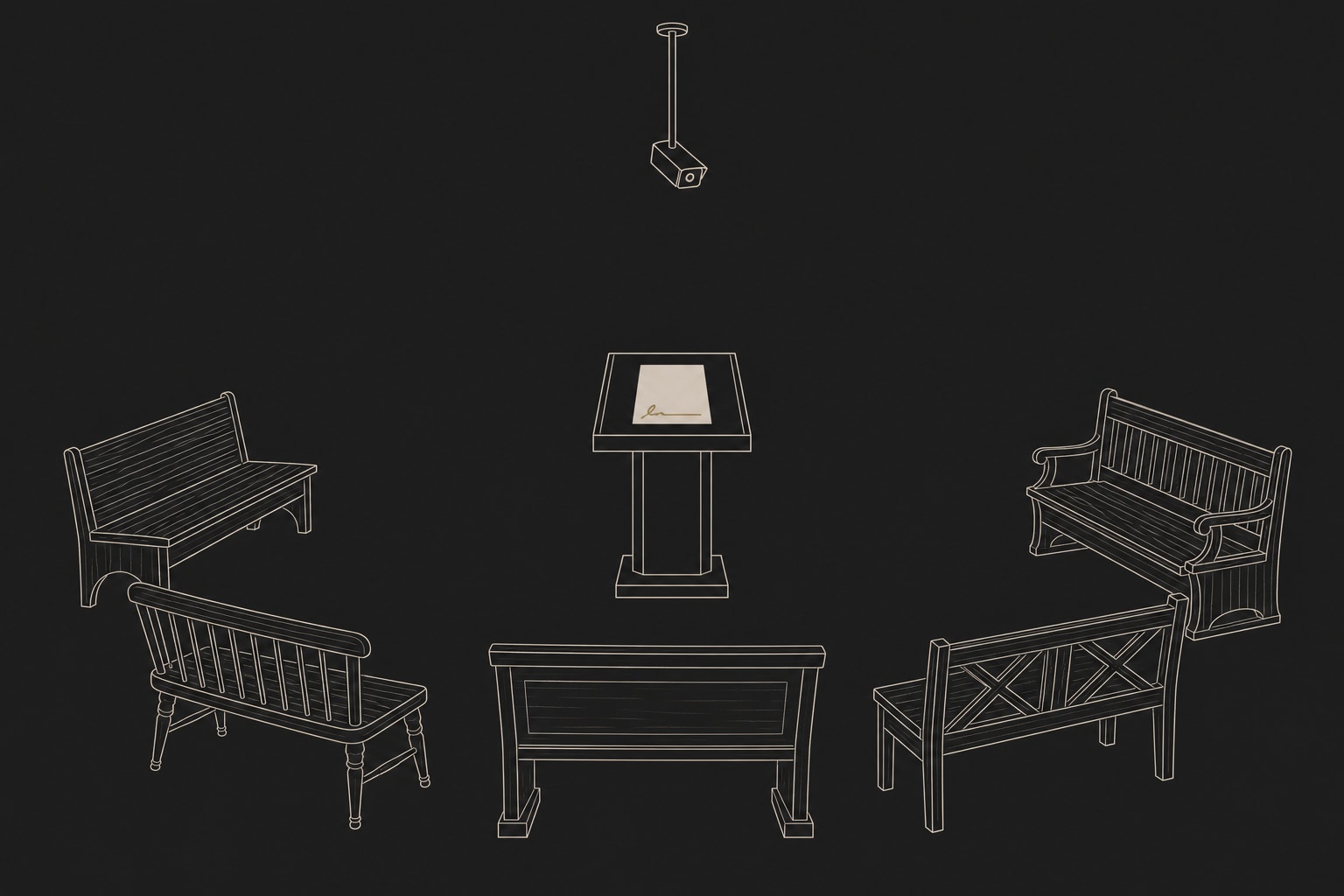
Five benches, one signature line, and a camera that never asked any of them for permission. That's the coalition, and it's already larger than the people who sold the cameras would like you to believe.

A monoline illustration of five distinct empty benches arranged in a semicircle around a lectern holding a single sheet with a brass signature line, watched by one camera overhead

Five benches, one signature line

Every seat in the room has its own reason to sign, and every reason holds.

Class C · AI-generated

03 / 06

What China, Britain, and America Show About Surveillance Disclosure

Skeptics reach for the same reasonable question, so let's answer it with the numbers rather than the nerves. The argument for disclosure gets stronger, not weaker, the further out you zoom.

China runs the largest surveillance apparatus in human history, and the scale is difficult to hold in the head. Roughly seven hundred million cameras feed its networks, which works out to something near four hundred and ninety cameras for every thousand people, or one camera for every two citizens, and it accounts for close to seventy percent of every surveillance camera on Earth. That's the model. That's where a watched society ends up when nobody stops to ask permission, and the distance between there and here is measured in exactly one thing: whether the citizen knows, and whether the citizen agreed.

Britain sits at the other end of the disclosure scale while committing plenty of the same excess. Eleven thousand ANPR cameras read close to fifty million plates a day into the National ANPR Data Centre, records sit for a year or more, and London alone carries north of a hundred and thirty thousand CCTV cameras, about thirteen for every thousand residents. The British went too far, and I've said so. Yet British law still forces the operator to put up a sign: the Data Protection Act, the UK GDPR, and the Surveillance Camera Code of Practice under the Protection of Freedoms Act all require visible notice telling the public that an area is watched, who's watching, and why. The most surveilled democracy in the West tells its people the truth on a signboard, and the least self-aware republic in the West hides the same cameras behind a corporate logo and a closed committee.

American courts are starting to notice. Norfolk, Virginia bolted a hundred and seventy-two Flock cameras across the city, and a federal judge, Chief Judge Mark Davis, let a Fourth Amendment challenge proceed, writing that "a reasonable person could believe that society's expectations are being violated by the Norfolk Flock system," which he found "notably similar" to the unconstitutional tracking in Carpenter. Norfolk's own police chief described the goal as building "a nice curtain of technology" that would make it "difficult to drive anywhere of any distance without running into a camera somewhere." He said the quiet part into the record. This bill simply asks him to print it on a sign.

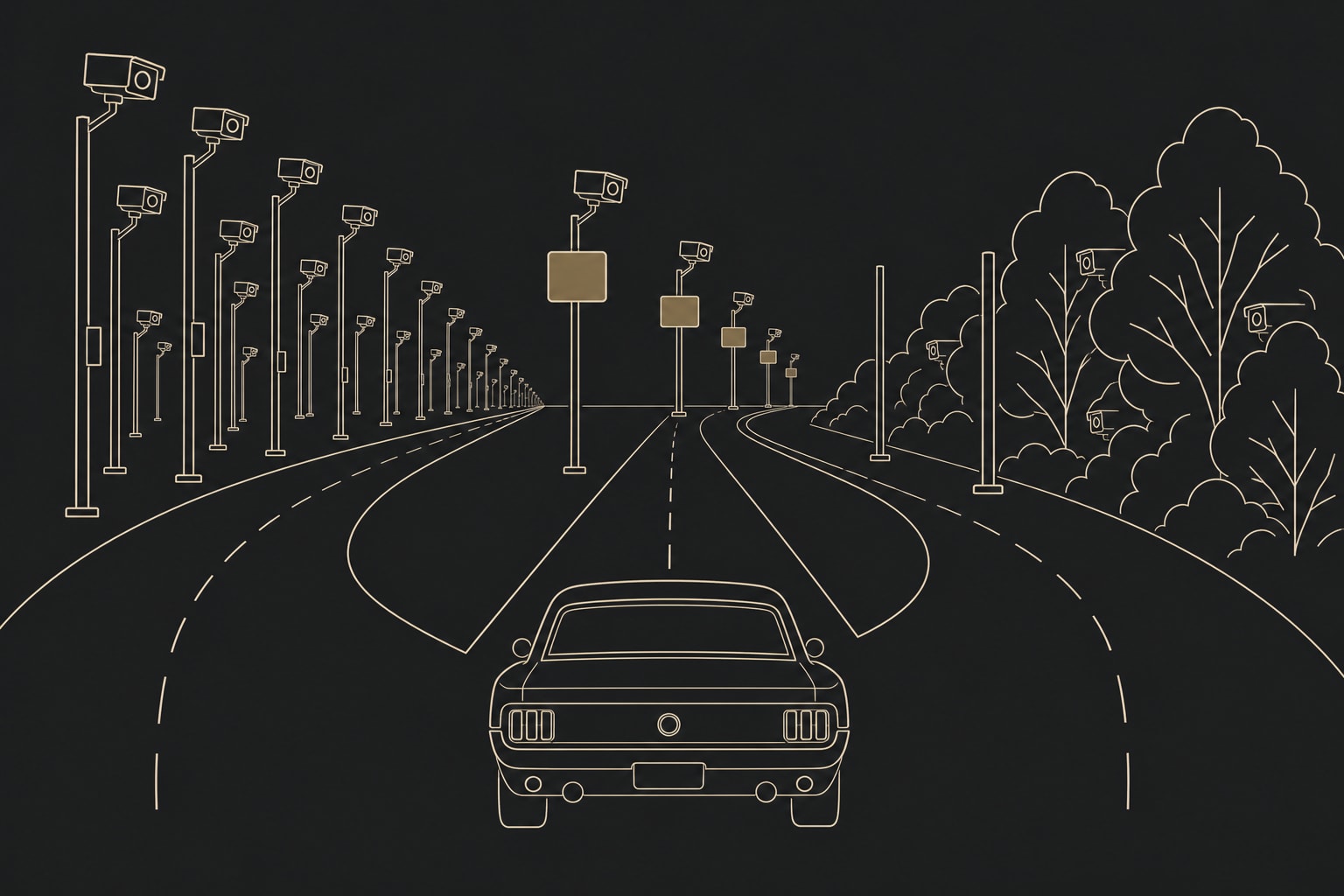
A monoline illustration of three roads receding to the horizon, one crowded with camera poles, one with cameras paired with disclosure signs, and one with cameras hidden among the trees, a classic car choosing between them

Three roads, one choice

The distance between a watched society and a free one is measured in whether the citizen knows, and whether the citizen agreed.

Class C · AI-generated

04 / 06

Questions About the Four Signs Law, Answered

Is this a real law?

Not yet, and that's the point of writing it as a bill you can sign. It's a model text, drafted to be carried into a city council meeting, a statehouse, or a ballot campaign and adapted to fit. Nothing here is enacted anywhere; everything here is meant to be.

Do you want to ban the cameras?

No, and read that twice, because it’s the objection everyone reaches for first. The Act removes no camera, blinds no investigator, and stops no legitimate case. It requires disclosure and the freedom to choose another road. A camera doing lawful work has nothing to fear from a sign announcing it.

That said, most of these cameras are completely unnecessary. My hope for the Act and its signs is that they raise awareness, so that citizens who suddenly see how watched their ordinary errands are will walk into the council chamber or the statehouse and ask for the pointless ones to come down. What I’d really like is a country where a fixed camera sits in a designated area with a genuine, documented crime problem, rather than on a random stretch of road, quietly generating revenue and tracking citizens on their way to work.

Aren't license plates public anyway?

A single plate glimpsed on a single street is public. The continuous, automated logging of every plate, everywhere, stored for months and searchable across the country, is a different thing entirely, and the Supreme Court said as much in Carpenter: aggregate enough public moments and you’ve built a private portrait the Fourth Amendment protects.

What about Amber Alerts and stolen cars?

Those uses survive this bill untouched, because the sign doesn't switch the camera off. A network chasing a genuine emergency loses nothing by being disclosed; it loses only the ability to watch everyone else in secret while it waits.

Why signs in all four directions?

Because a disclosure you can't see before the camera reads you isn't a disclosure, it's a receipt. A driver approaching from any road deserves the same warning, which means a sign facing each way in, posted far enough back that a person can still choose to turn.

Who pays for the signs?

The party that chose to do the watching. If a surveillance network can afford ninety thousand cameras and a national database, it can afford the signboards that tell people the cameras are there.

Isn't this just anti-police?

Ask the police, some of whom agree. Staunton, Virginia’s chief called the residents raising these concerns "democracy in action" before his own department ended its Flock contract. More than thirty localities have paused or canceled since early 2025. This is citizens and officials together asking for daylight, which is the opposite of a fight.

Government surveillance or private surveillance, which is this?

Both, braided together, which is what makes it slippery. A private company owns the pole, the government searches the data, and each points at the other when you ask who’s accountable. The Act cuts through the braid by regulating any network a government can search, no matter whose logo is on the housing.

05 / 06

Offered for Signature

Sign as a citizen, a co-sponsor, or a keeper who'd like to know when the road is watching. Print it, pass it, and carry it up the steps: to a council chamber, a statehouse, or a ballot campaign, adapted to fit the jurisdiction that receives it. The Convoy carries the companion petition from the first piece, asking every council to bring existing and proposed plate-reader contracts out of the consent agenda and into a published, debated, recorded vote, with the camera map, the crime map, the sharing list, and the audit on the table before a single renewal.

Add your name to the Convoy.

Filed by a keeper, on behalf of everyone who'd like the courtesy of a sign.

06 / 06

Sources

  1. ACLU of Massachusetts, "Flock Gives Law Enforcement All Over the Country Access to Your Location," Oct. 7, 2025. data.aclum.org
  2. NPR, "Why some cities are ditching their Flock license plate readers," Feb. 17, 2026. npr.org
  3. Institute for Justice, "Judge Rules Lawsuit Challenging Norfolk's Use of Flock Cameras Can Proceed." ij.org
  4. The Record (Recorded Future News), coverage of the Norfolk Flock litigation. therecord.media
  5. Carpenter v. United States, 585 U.S. ___ (2018), U.S. Supreme Court. supremecourt.gov
  6. Comparitech, "The world's most surveilled cities." comparitech.com
  7. Wikipedia, "Automatic number-plate recognition in the United Kingdom." en.wikipedia.org
  8. Cyber Defense Magazine, "UK ANPR systems are one of the world's biggest surveillance systems." cyberdefensemagazine.com
  9. GOV.UK, "Surveillance Camera Code of Practice" (Protection of Freedoms Act 2012). gov.uk
  10. Protection of Freedoms Act 2012, legislation.gov.uk. legislation.gov.uk
  11. Wikipedia, "Mass surveillance in China." en.wikipedia.org
  12. ACLU, "Get the Flock Out" campaign. aclu.org
  13. Malwarebytes, "The backlash against Flock cameras is spreading," July 2026. malwarebytes.com

This document is a work of advocacy and a model bill drafted for public discussion. It is a proposal, not enacted law in any jurisdiction, and it isn't legal advice. Every statistic, quotation, and case citation is drawn from the published sources listed above and reproduced as faithfully as reporting allows; figures on camera counts and surveillance scale are estimates from those sources and shift over time. Carry it, adapt it, argue with it, and improve it.

Tags

surveillanceflock-safetyalprprivacymodel-billfourth-amendmentthe-long-read