The Long Read · Minnesota
The Cameras Came Quietly
Minnesota bolted itself to a national surveillance network one consent agenda at a time, and the record those cameras keep is a record of you.
The premiere
I watched the first season of Black Mirror the way you watch a horror film set on a spaceship, which is to say comfortably, under a blanket, in Minnesota, secure in the knowledge that none of it could follow me home. The show ran its thought experiments about screens that watch you back, and I admired the craft and went to bed.
Then China built the production version, a lattice of hundreds of millions of cameras wired to digital IDs and, eventually, to social credit scores that decided whether a citizen could board a train, and I read about it over coffee with the particular smugness of a man whose state’s idea of surveillance was a neighbor keeping unofficial records on the length of my lawn. That was a them problem. We had a Constitution, a Fourth Amendment, and a long national tradition of telling the man with the clipboard to get off the porch.
The smugness held right up until a man named Joel Feder drove a Range Rover to a Kohl’s in Plymouth and the science fiction met him in the parking lot, which is, you’ll agree, the least cinematic venue a dystopia has ever chosen for its premiere. Feder reviews cars for a living, the Range Rover wore dealer plates, and a roadside camera misread them, decided the truck was tied to a stolen or missing plate, and summoned squad cars from multiple directions with lights, sirens, and hands resting on holsters, all to apprehend a motoring journalist mid errand. The machine had made a small clerical error, the kind a shoebox of receipts makes constantly, except this shoebox can dispatch armed men to a department store. Feder put it plainly afterward: “humans make errors, it got amplified by a nationwide surveillance system.” He was gracious about it, which is more than the system deserved and more than I’d have managed outside a Kohl’s.
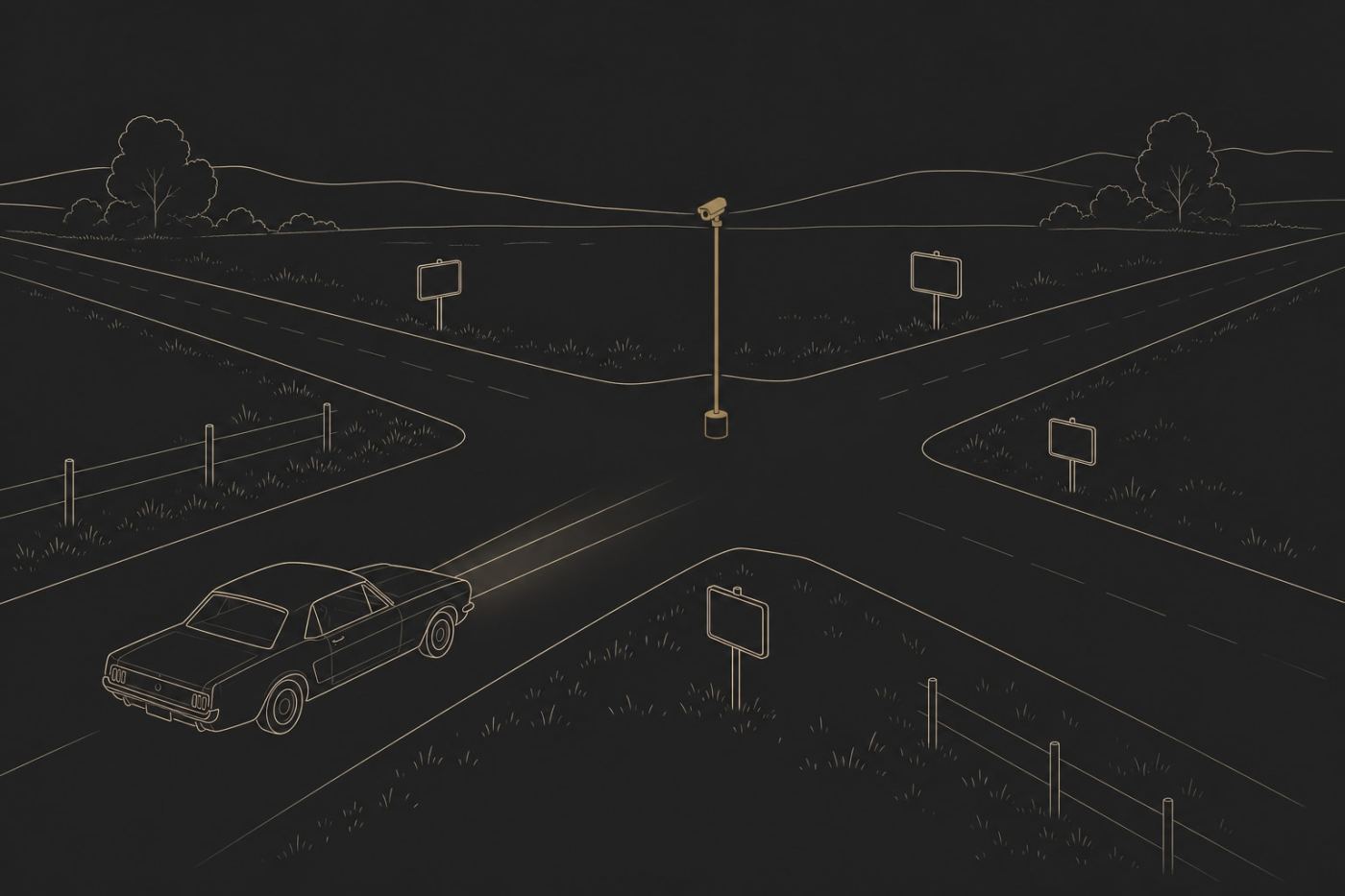
So the question stopped being whether the cameras from the television show could reach my home state. They arrived years ago, on poles, at intersections, and at the gated mouths of expensive neighborhoods, and they did it the Minnesota way, quietly, politely, and without making a fuss, which is why almost nobody remembers voting for them, because almost nobody did.
The consent agenda
How Flock Cameras Were Approved Across Minnesota Without a Public Vote
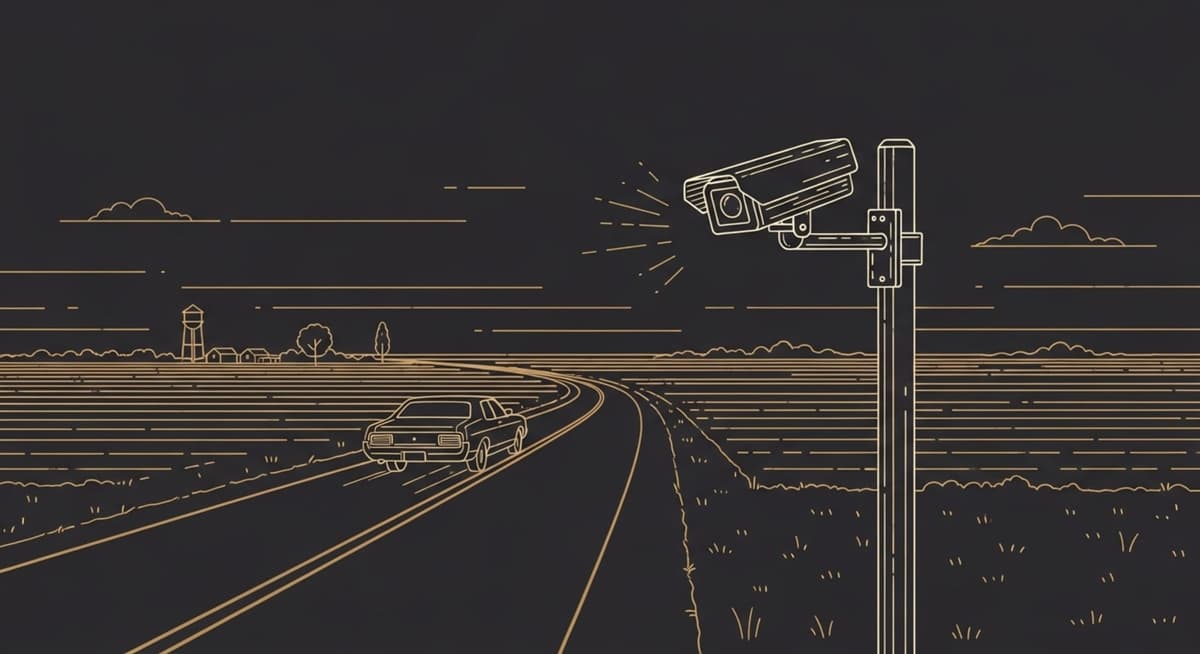
Flock Safety is an Atlanta company, valued around $7.5 billion, that has hung more than 100,000 automated license plate readers across the country for roughly 12,000 clients, and its genius was never the camera, because the camera is a modest thing on a pole with the approximate charisma of a birdhouse.
The genius was the sales channel, because Flock skipped the voters entirely and sold to police departments, county sheriffs, homeowner associations, and mall owners on tidy annual subscriptions, which means a national surveillance grid arrived in Minnesota the way a gym membership arrives on a credit card statement, automatically, renewably, and long after anyone remembers signing up.
Prior Lake pays about $3,000 per camera per year, Columbia Heights signed a three-year deal worth roughly $151,000, and North Oaks, a town so private the roads themselves are members-only, ran a pilot at its entrances in late 2024 before upgrading this April to a five-year contract covering every way in, so the community famous for asking you to turn around now photographs you while you do it. Anoka County signed up in 2023 and posted ten of them around the county.
Notice the shape of that list, because it’s a pilot here, a renewal there, a line item wedged between the plow blades and the printer toner, each one approved in a council chamber on a weeknight while the rest of us were home watching something on a screen that was, in a pleasing irony, probably about surveillance.
The state’s own records now show more than 500 fixed plate readers operated by law enforcement across Minnesota, and Flock says it contracts with more than 100 police agencies here, which is a remarkable footprint for a program nobody ran on, nobody mailed a ballot question about, and nobody stood up to defend at a single lake association meeting. The network assembled itself out of a hundred small, sleepy yes votes, and the Bureau of Criminal Apprehension keeps the list of who joined, which is how we know how big the congregation got before anyone heard the sermon.
Listen, too, to the sales language, because surveillance never arrives in a community introducing itself as surveillance. It arrives saving children, solving crime, or doing something wonderful, and the brochure somehow never reaches the paragraph explaining what the wonderful thing requires, which is filming and tracking the real-time movements of every citizen who drives past, the guilty and the innocent alike, on the school run, the church run, and the midnight run for diapers, and cataloging all of it in a central repository that government entities, and anyone else who finds the keys, can reach into at will.
The pitch sells the one recovered stolen car, and the price is the logged whereabouts of everyone who ever owned a car legally, a trade nobody would take if it were once described out loud at the meeting.
Responsibility, once you go looking for it, turns out to be a hall of mirrors. The council approves the contract, the police department owns the policy, the chief or a designee authorizes each search, the vendor owns the cloud, and the audit happens every two years if it happens at all, so ask who is accountable for the camera on your corner and you’ll be handed a flowchart with no face on it, drawn by a committee that has since adjourned.
The map vs. the crime
Where Flock Surveillance Cameras Are Placed, and Why the Locations Ignore Minnesota Crime Data
Here is the part that should bother you even if the word privacy makes you yawn into your coffee. A camera network sold as a crime-fighting tool should sit where the crime is, the way a fishing boat sits where the fish are, and Minnesota’s readers sit instead at street corners, outside malls, at the entrances of high-end neighborhoods, and, in one case a columnist noticed up on the Iron Range, next to the gas station where he buys his dump tickets.
An investigation by Unicorn Riot into the Minneapolis plate-reader network found 30 camera-equipped intersections that logged 31 million vehicles in two months and matched 12,446 stolen ones, a hit rate of 0.039 percent, which in any other industry would be described as a rounding error with a budget. The same investigation found the cameras concentrated in Near North, a majority-Black area with five camera intersections, while Whittier, with twice the population and a higher auto-theft rate, got three, and a researcher with the DeFlock mapping project, Ed Vogel, warned the tools will simply “reinforce the racist and classist ways in which police operate.”
Ask a department how it chooses locations and you’ll hear about traffic flow, ingress points, and investigative value, which is procurement language for wherever the vendor’s rep pointed during the demo. Minnesota law requires each agency to keep a public list of its fixed camera locations and a public log of use, so the receipts exist, and the methodology connecting those locations to crime data is the one document nobody, in any city, seems able to produce on request, which suggests it lives in the same drawer as everything else this state has ever meant to get around to filing.
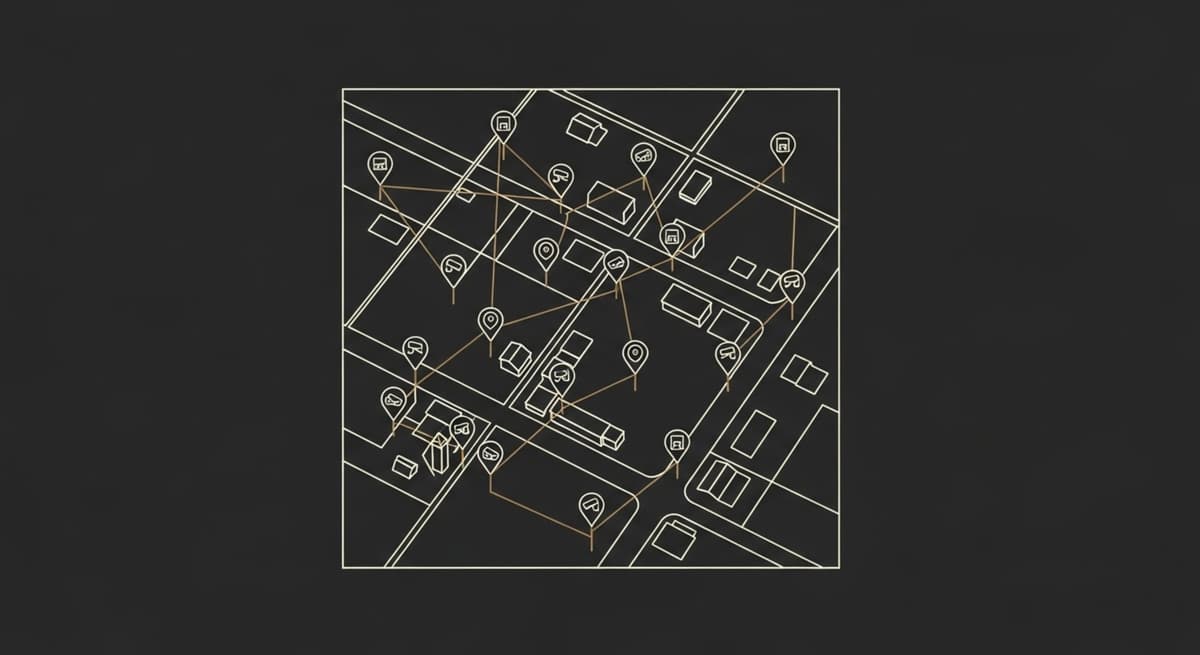
The camera map versus the crime map
The cameras cluster where the contracts landed, not where the crime data points.
The evidence
What the Research Says About Flock Safety Crime Reduction Claims
Flock’s marketing rests on a February 2024 study announcing that its technology is instrumental in solving 10 percent of reported crime in America, which is a spectacular number, and it should be, because Flock employees wrote the study. Did the number survive contact with anyone outside the Flock payroll? It did not.
Two academics from Texas Christian University and the University of Texas at Tyler lent oversight to the project, and one of them, criminologist Johnny Nhan, later told the journalists at 404 Media he had concerns about how the research was conducted and would have handled it differently, which is academic dialect for a five-alarm fire.
Forbes went and checked one of the company’s favorite anecdotes, an 80 percent drop in residential burglaries in San Marino, California, and found burglaries had ticked slightly upward, and the surveillance research firm IPVM tested a Flock camera in 2021, measured a 10 percent error rate, and promptly lost the ability to buy Flock products, a corporate reflex you’ll recognize as unplugging the smoke detector.
Run the company’s own accuracy claim through basic arithmetic and the picture darkens further. Flock says 20 billion vehicles pass its cameras every month and that its readers capture plates correctly 93 percent of the time, and 7 percent of 20 billion is a monthly mountain of misreads, each one a candidate to become somebody’s Joel Feder moment outside somebody’s Kohl’s. A carburetor that fueled correctly 93 percent of the time would be in the parts bin by Saturday morning, and we’ve wired this one straight to the dispatcher.
The camera is a modest thing on a pole. The database behind it is a diary of everyone, written without permission, stored out of state, and lent to strangers.
The Convoy · Long Read No. 2
The keys to the diary
Who Can Access Minnesota License Plate Reader and Security Surveillance Data
Flock likes to say its customers own their data, which is true the way a hotel guest owns the minibar. Any law enforcement agency in the network can be granted a look, and the sharing toggles have a documented habit of sitting wider open than the locals realized.
Anoka County’s transparency portal showed its plate data flowing to more than 850 agencies around the country, a list that included the U.S. Postal Inspection Service and, magnificently, the Indiana Dunes National Park Police, presumably in case a Corolla from Coon Rapids ever menaces a sand dune 400 miles away. The county removed both federal agencies from the list only after reporters from 5 INVESTIGATES started asking why they were there, which is the transparency portal equivalent of tidying the garage because your father-in-law is coming.
The immigration chapter is darker. Flock insists it holds no contracts with ICE, and the ACLU has documented how little that assurance covers, because any client department can run a search on a federal agency’s behalf, and audit logs in other states have shown exactly that happening at scale.
Flock’s own chief executive, Garrett Langley, denied federal entanglements right up until the company admitted it had been running a pilot with Customs and Border Protection, after which he offered the all-time entry in the corporate apology genre: “We clearly communicated poorly.” The ACLU of Minnesota’s policy counsel, John Boehler, has spent months explaining the mechanics to city councils, noting that once your city’s data leaves for an agency in a county with a federal immigration agreement, state law follows it on paper and nothing follows it in practice. Minnesota’s statute is better than most, and it still leaks.
Sit with the architecture for a second. A private company’s cloud holds a time-stamped map of your church, your clinic, your union hall, your ex’s driveway, and your Friday night, searchable by tens of thousands of badge holders you have never met, protected by a checkbox someone in another city may have ticked by accident. George Orwell gets invoked too often in these arguments, so I will reach for something worse: this is Black Mirror written by a procurement officer, and it billed annually.
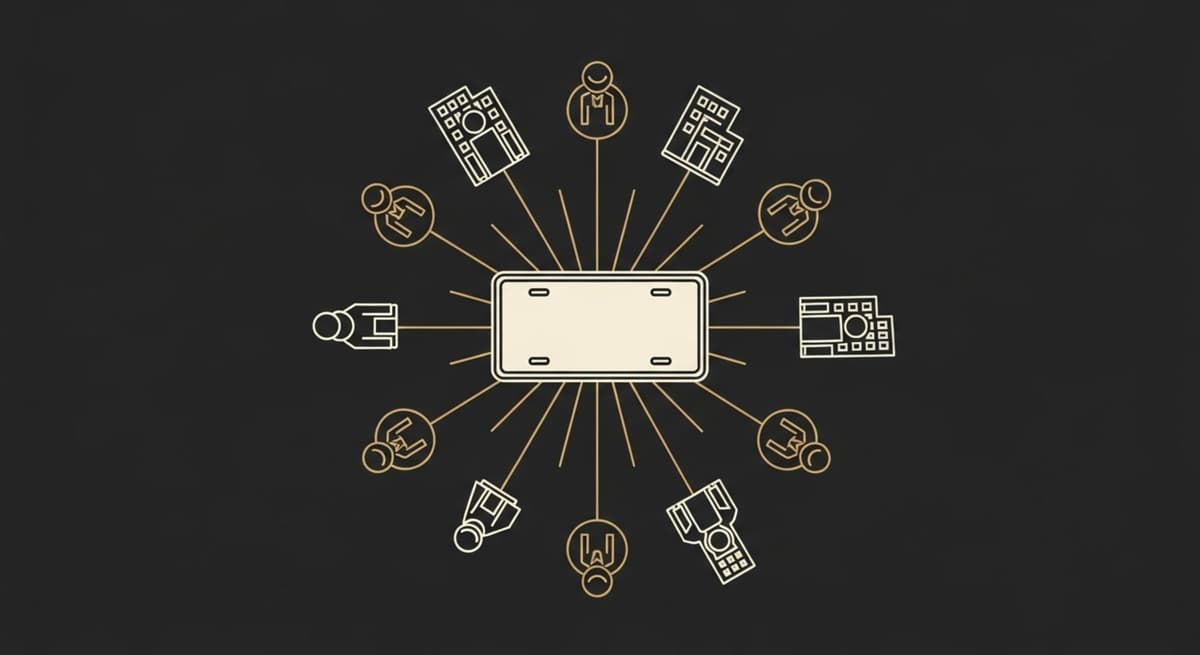
One scan, lent outward
One plate scan, quietly lent outward to agencies and strangers far beyond the town that captured it.
The turning
The Minnesota Cities Canceling Their Flock Camera Contracts
The good news, and there is genuine good news, is that the quiet approvals have stopped being quiet, because Minnesotans will tolerate a great deal without complaint, road construction, February, and the Vikings, but being tracked without being asked turned out to sit outside the tolerance band, and when this state finally decides to say something out loud, it says it unanimously.
Columbia Heights, one of the most diverse cities in the state, held a packed town hall on May 14, a council work session on June 1, and a unanimous vote on June 8 to tear the whole system out, twelve cameras, contract paid off and cancelled, done. Mayor Amáda Márquez Simula, who took real heat from every direction, wrote afterward about the moment we are living in and closed with six words that deserve framing: “This isn’t no. It’s not yet.”
Brooklyn Park let its $24,000 Flock contract lapse after its own department noticed other agencies dipping into the data without the case numbers state law demands. Shorewood switched off its lone camera until an audit says who has been reading its diary. Champlin put the question on the agenda. Mankato residents, led by an organizer named Ava Corey-Gruenes, beat back a citywide proposal before it started, and her math was the simple kind that holds up: “The harm that can come from using this technology, I feel, outweighs the benefits.”
St. Paul is arguing about it in the open now, which is where arguments like this belong. The police department told the council’s Public Safety Committee that every search is limited, documented, and audited, and Deputy Chief Kurt Hallstrom gave the debate its best sentence from the pro side: “Public safety and constitutional rights are not competing values.” He is right, and the way you prove they are not competing is precisely what the ACLU asked for in that same room, cutting off data sharing with every jurisdiction that signed up to do federal immigration work, publishing the audits, and letting the public grade the homework for once. The legislature is circling too, with a bill that would shrink retention from 60 days to 48 hours and pull the data into state custody. Watch what happens to it.
Switched off, city by city
Columbia Heights, Brooklyn Park, Shorewood — city by city, the cameras are being switched off.
A modest proposal
A Modest Proposal to Point the Flock Surveillance Cameras at the City Council First
I’ll close with an offer every council in Minnesota can act on tomorrow, at no cost beyond a little dignity. Every council member who votes to keep the cameras gets a matched pair of them, one at each end of the street where they live, for one year, and the public gets to view the results, restricted, in fairness, to the movements of the elected officials themselves.
We’ll see when they leave for the cabin, when they get home from the fundraiser, how long the car sat outside the clinic, and which meetings never made the minutes, and then we, the watched, get to decide whether the technology is good, applying precisely the standard they applied to us, which is to say none at all.
The offer is fair to the point of generosity, because a council member’s street would enjoy every protection ours allegedly enjoys, the stolen Corollas flagged, the missing elders found, the full advertised bounty of the subscription, and I can still predict the take-up, because precious few council members would accept a year under their own product, and every keeper in Minnesota should sit with what that refusal admits. A tool you’d never point at your own street has no business pointed at ours.
Sign the petition
Put every plate reader to a public vote.
The Convoy is calling on every Minnesota city council to bring existing and proposed license plate reader contracts out of the consent agenda and into a published, debated, recorded vote, with the camera map, the crime map, the sharing list, and the audit on the table before a single renewal.
The petition carries the reciprocity clause: any council that votes to keep its cameras accepts a matched pair on its own members’ streets for one year, with the results public. Surveillance of everyone deserves, at minimum, a conversation with everyone.
The keeper’s stake
The biography of a car belongs to the people who kept it
Autodyssey exists because we believe a documented car is a more valuable car, so understand that our quarrel was never with the record. Our quarrel is with who holds the pen.
The Vault is a record a keeper builds by choice, owns outright, and passes forward as provenance, one steward to the next, and a plate reader is a record made of you, held by strangers, for purposes you will never be asked about. Every keeper is a temporary steward of a machine that will outlast them, and stewardship includes the road itself, the plain right to drive to the lake, the shop, or nowhere in particular without contributing a timestamped entry to somebody else’s ledger.
The biography of a car belongs to the people who kept it. Defend that, and defend the road it drives on.
The Vault
A record you build by choice and own outright.
Provenance Score
Climbs with every entry you add.
Vehicle Passport
Proves the car is exactly what you swear it is.
Ancestry
Threads every owner's chapter back to one VIN.
The keeper's road
The open road was the last place a car got to be nobody’s business.