
AUTODYSSEY

The Year You Were Born · Issue 1988

The cars of 1988, and the one that did everything in second gear

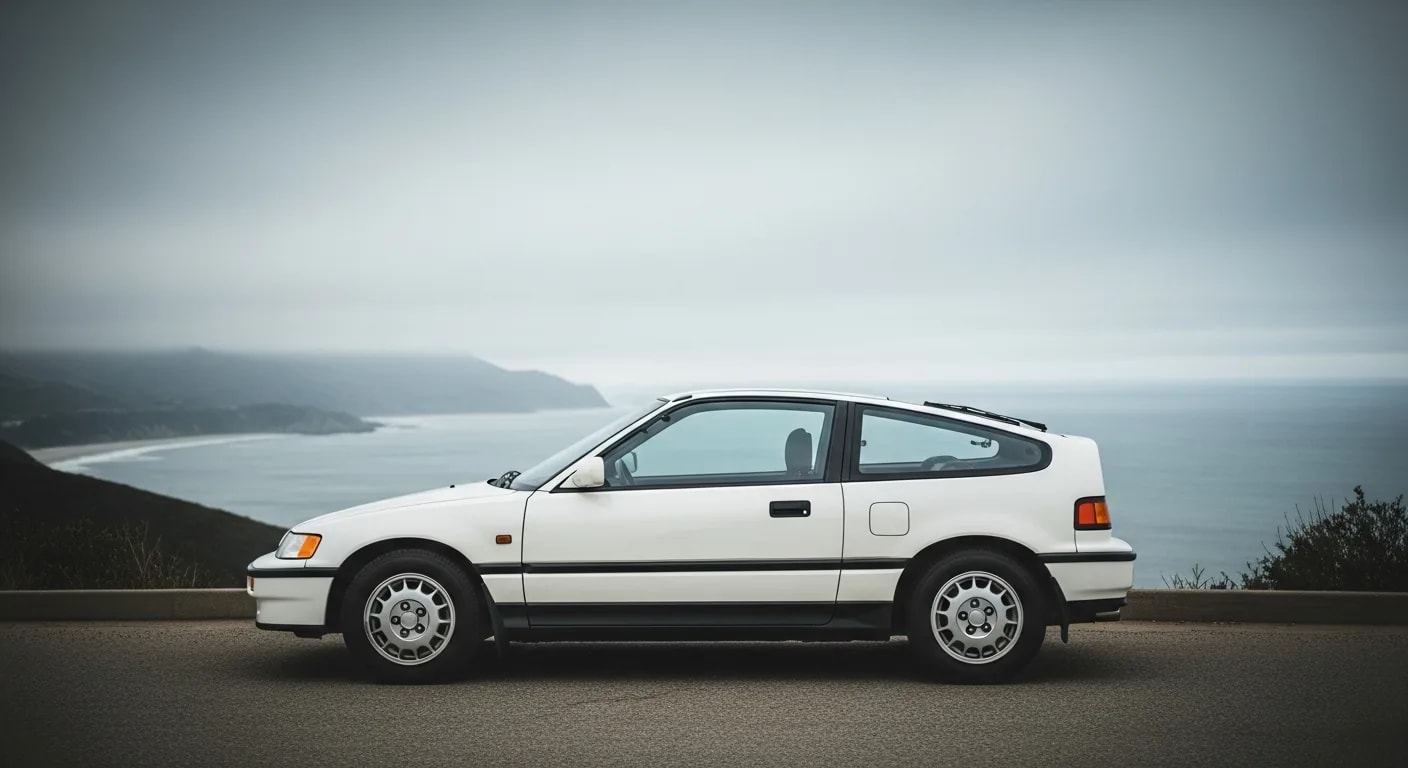
Honda sold more Accords in 1988 than Ford sold Escorts — the first time a Japanese car had topped the American sales chart. Three blocks away in Honda's product line, a small sports car with a 9,000 rpm redline was selling to buyers who had been told that Japanese cars were practical and reliable. The CRX Si was not interested in those adjectives.

Series
The Year You Were Born
Issue
Vol 01 · 1988
Topic
Automotive Archaeology
Length
~12 min read
Start reading ↓
01 · The Year

The year Japan won the quality argument and nobody wanted to admit it

1988 was the year that the American car market's cultural center of gravity shifted in a way that was visible in the sales numbers and undeniable to anyone who compared what Honda was building to what GM was building at the same price. The Accord's number-one position was a commercial fact that became a cultural one: the most popular car in America was Japanese, and the reason was quality, not price. The Accord was not the cheapest car in its segment. It was the best-built car in its segment, and buyers had figured that out.

The domestic industry's response was complicated. Quality improvement programs had been underway at GM, Ford, and Chrysler for several years, with results that were real but lagged the Japanese advantage by a margin that customers could measure. The Chevrolet Cavalier and the Ford Escort were competent cars in 1988; they were not as competent as the Honda Civic or the Toyota Corolla at the same price. Reagan was in his last year in office. The Berlin Wall was still up. The Dodge Viper was in development. The context was a market in transition and an industry in the process of a painful recalibration.

Average new-car price
$12,470
Gallon of gasoline
$0.95
US cars sold
10.5 million
Cultural moment
Seoul Olympics, Reagan's last year
02 · The American Top Ten

What America bought in 1988

The 1988 American top ten is the moment of Japanese commercial triumph. The Accord at number one is the headline, but the Civic's position in the top five and the Toyota Camry's continued growth tell the same story from different angles. The domestic manufacturers were not absent from the list, but they were defending, not advancing.

01
Honda Accord

The Accord's first appearance at number one is the marker event for the American car market of the late twentieth century. The car earned the position the hard way: by being consistently well-built, consistently reliable, and consistently improved with each model year in ways that buyers noticed and rewarded. The 1988 Accord in LX or LXi trim is the car that established Honda's reputation among American buyers of a certain age, and that reputation has not required revision.

02
Ford Escort

The Escort was the domestic small car that sold in the largest numbers, and it sold to buyers who chose it because of price and familiarity rather than quality. The Escort was not a bad car in 1988; it was a car that was better than it had been and not quite as good as what it was competing with. The GT version with the twin-cam engine from Yamaha was the most interesting Escort, and the rarest.

03
Chevrolet Cavalier

The Cavalier sold to buyers who wanted a domestic small car and shopped at Chevrolet dealers. The Z24 package with the 2.8-litre V6 was the most interesting version and the one that attracted buyers who might otherwise have considered a CRX Si, though the dynamics of the two cars were not comparable.

04
Toyota Camry

The Camry had entered the American market in 1983 and was by 1988 establishing the trajectory that would eventually make it the perennial best-selling passenger car in America. The 1988 Camry LE was a larger, more refined car than the Accord in some measures, and it competed directly with the Accord for buyers who wanted a mid-size Japanese sedan. Both were excellent cars. The Camry was quieter. The Accord was more fun to drive.

05
Ford Taurus

The Taurus had launched in 1986 and was the domestic mid-size car that came closest to matching the Japanese cars on quality and design. The aerodynamic body was a genuine departure for domestic mid-size cars, and the interior packaging was thoughtful. The SHO version arriving later would be the most interesting Taurus, but the base car in 1988 was already the best domestic mid-size.

06
Oldsmobile Cutlass Ciera

The Ciera continued to sell in large numbers to buyers who were loyal to the Cutlass nameplate and did not notice or did not care that the car it was attached to had changed substantially. The Ciera was a competent front-drive family car with a brand name attached to a legacy it was not quite living up to.

07
Chevrolet Celebrity

The Celebrity was completing its run as GM's best-selling mid-size car and would be replaced by the Lumina in 1990. The 1988 Celebrity is the late-career version of a car that sold consistently because it was reliable and familiar. It asked nothing of its owner and delivered nothing beyond the contract, which is a kind of excellence.

08
Pontiac Grand Am

The Grand Am was the sporting interpretation of GM's N-body platform and sold well to buyers who wanted the visual vocabulary of a sports car without the dynamics. The 2.3-litre Quad 4 engine that powered the GT version was genuinely interesting — revvy, powerful for its displacement, and the most technically ambitious engine GM had produced in a decade.

09
Ford Tempo

The Tempo was still selling to buyers who wanted an affordable domestic compact and were committed to Ford dealerships. The 1988 Tempo is a car that did what was asked of it without complaint, which is the correct description of an honest transportation appliance.

10
Honda Civic

The Civic's appearance at number ten is the second half of the Honda story in 1988: the Accord at one and the Civic at ten represent two price points, two size classes, and one manufacturer's complete command of what American buyers wanted from Japanese cars. The Si hatchback with the 1.5-litre twin-cam was the version that driving enthusiasts recommended.

Editorial detail from 1988

Detail · 1988

03 · The Rest of the World

What the rest of the world drove

Europe in 1988 was producing the cars that are now the subject of enthusiast nostalgia and serious money. The E30 BMW M3 had arrived. The Peugeot 205 GTI was at its peak. The Golf GTI 16v was the benchmark. Japanese manufacturers were about to launch the NSX, the Skyline GT-R, and the Mazda MX-5, all within twenty-four months.

United KingdomFord Sierra RS Cosworth

The Sierra Cosworth is the car that proved a family saloon could be a genuine performance car without any visible concessions to the family saloon brief. The turbocharged 2.0-litre Cosworth engine produced 204 horsepower, the rear wing was non-negotiable, and the 0-60 time was 6.2 seconds. The RS Cosworth attracted a certain kind of buyer and a certain kind of unwanted attention from people who wanted to steal it.

GermanyBMW M3 (E30)

The E30 M3 was built to win the Group A touring car championship, homologated with a 2.3-litre four-cylinder producing 195 horsepower, and is now one of the most sought-after BMWs ever built. The production car was a precise, physical, demanding thing to drive quickly. The racing cars won in a way that justified every compromise the road car made.

FrancePeugeot 205 GTI 1.9

The 1.9-litre version of the 205 GTI arrived in 1986 and by 1988 was the definitive hot hatchback. 130 horsepower, 960 kilograms, and a suspension balance that rewarded the driver who understood that the rear of the car would follow whatever the front started. The 205 GTI 1.9 is fast in a way that depends on the driver, which is the best kind of fast.

ItalyLancia Delta HF Integrale

The HF Integrale arrived in 1987 and by 1988 was winning World Rally Championships with a combination of four-wheel drive, turbocharging, and a willingness to be spectacularly sideways that made it the most entertaining car in international rallying. The road car retained the mechanical essence and enough of the entertainment to justify its now-considerable price.

JapanHonda CRX Si

The second-generation CRX Si produced 105 horsepower from a 1.6-litre DOHC engine, weighed 2,100 pounds, and drove with a precision and immediacy that cars costing three times as much could not match. The rev counter was the interesting instrument. The tachometer redlined at 7,200 rpm and the engine preferred to be above 5,000. In 1988 it cost $10,935. A well-maintained example today is worth considerably more than that.

04 · Our Pick

Our pick from 1988

Honda CRX Si
Why this one

The CRX Si is the car that proved lightness was a performance specification rather than a compromise. Two seats, a 1.6-litre twin-cam engine, 2,100 pounds, and a chassis that communicated everything the road was doing in terms that required no interpretation. The 105 horsepower sounds modest; the experience is not, because the car uses all of them all the time. The gearbox has a short-throw shift that responds precisely and rewards the driver who uses it correctly. The brakes are sized appropriately for a car this light. Nothing is excessive and nothing is absent. It is the benchmark against which affordable sports cars are measured and found wanting.

What to watch for

Rust in the lower sills and the rear hatch area. The second-generation CRX rusts predictably, and a car that is presentable from standing height can have significant rust at wheel-arch level and below. The DOHC Si engine requires attention to valve adjustment intervals — Honda specified 15,000-mile valve adjustments, and cars that have missed them develop ticking that becomes worse. The original Si required 91-octane fuel and the compression ratio makes modern 87-octane a compromise. Find a Honda specialist rather than a general mechanic.

What to pay in 2026

A solid driver-quality 1988-1991 CRX Si runs between ten and eighteen thousand dollars in 2026. Low-mileage, unmolested examples — no body kit, original paint, service history — command twenty to twenty-eight thousand dollars from buyers who understand what they are purchasing. The standard HF and DX models are a third the price with a fraction of the driving engagement. The Si is the one to buy.

For the Vault

The original Monroney sticker if it survived. The Honda dealer service records if the car was maintained at a dealership. A record of every valve adjustment — when it was done, by whom, what the clearances were. The original owner's manual. Photographs of the underside before any restoration. The CRX Si is now a collectible car in a small body, and the record of a well-maintained example is part of what makes it worth what it is worth.

05 · Closing

Why 1988 is the year the Japanese sports car found its brief

The CRX Si is the beginning of a generation of Japanese sports cars — the Miata, the NSX, the S2000, the GT-R — that took the sports car brief seriously as an engineering problem and solved it in ways that European manufacturers had not expected from Japan. The lesson the CRX Si taught, which the Miata confirmed in 1990 and the NSX confirmed in 1991, was that the best sports cars are not the most powerful ones but the ones that deliver the most of what a driver actually experiences while driving.

That lesson is now absorbed into the common engineering culture of sports car development, and the CRX Si is the car where it was first available for eleven thousand dollars. Start a Vault the week you acquire one. The car's mechanical simplicity means its record is readable: the valve adjustment intervals, the timing belt replacements, the brake pad changes — a complete service history on a CRX Si tells you exactly how the car was treated. That record is the difference between a car that is right and a car that is merely available.

From the editor

The car from the year you were born is the only classic that already knows your birthday. Start the Vault the week you bring it home, and forty years from now the record will be worth more than the car. Both will be priceless to whoever inherits them.

Autodyssey · The Magazine · Vol 01
1988 · The cars of 1988, and the one that did everything in second gear · Autodyssey