
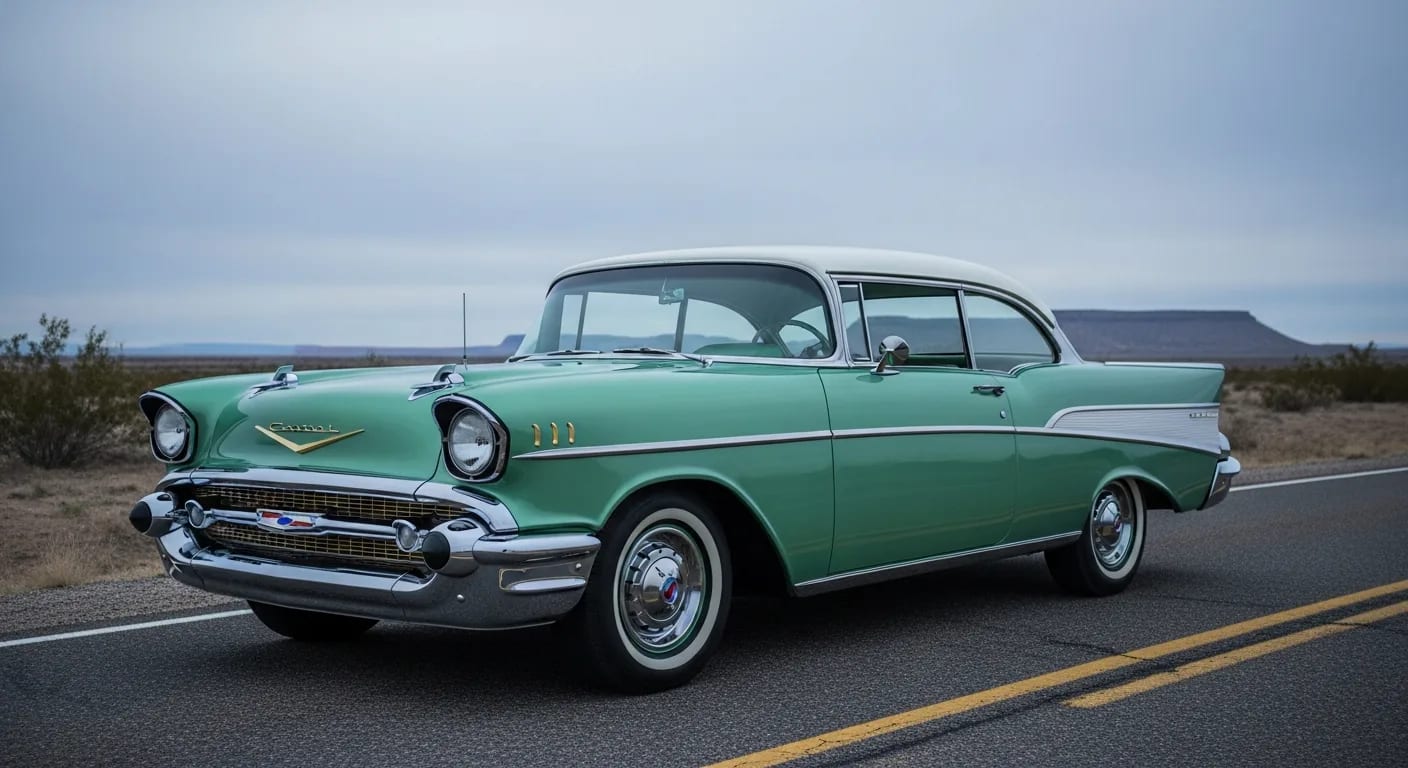
Chrome, horsepower, and the last uncomplicated year
1957 was the year the American car reached its aesthetic peak and refused to come down. Eisenhower was in his second term, the suburbs were spreading faster than anybody had planned for, and the country had decided that the automobile was both a practical necessity and a sculptural statement. Detroit obliged. The cars of 1957 are heavier, longer, lower, and more chrome-covered than anything before or since, and the best of them are beautiful in the way that a yacht is beautiful — not because it pretends to be practical but because it commits entirely to what it is.
Underneath the chrome, the engineering was genuine. The small-block V8 that Chevrolet had introduced in 1955 was now available with fuel injection, producing one horsepower per cubic inch — a metric that engineers speak of quietly and reverently. Ford had its own Y-block V8. Chrysler had its Hemi. Pontiac had just introduced the first Trans Am. The horsepower race was not a marketing exercise; the cars actually went fast, stopped imperfectly, and handled in the manner of boats, which was the accepted standard. Gas cost about twenty-four cents a gallon. Nobody was worried about that.
